Wednesday, June 8, 2011

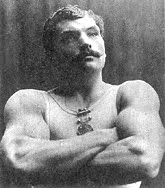
THE DEVELOPMENT OF PHYSICAL POWER - (Circa 1906) - Chapter 1 - MY EARLY DAYS - By Arthur Saxon


*Editors Note: The book did not actually have numbered chapters. They were just separated by topic headings. I numbered them as "Chapters" to make it more orderly for the reader. Some were combined as they were very short.


As stated in the introduction to this book, I should be untruthful did I follow the example of certain strong men who have made it their business to say they were weakly invalids at the commencement of their training, but, by a secret method, made themselves into strong men. I reiterate the fact that only one man in every hundred has the chance of becoming a champion weight-lifter. To pose successfully as such, one must, in the first instance, be born with the constitution of a horse, and with a sound physical make-up, both externally and internally, good bones and a strong will. Also, of course, the wish and ambition to be a "strong man."

I must admit that the manner in which my youthful days were spent has stood me in good stead in my latter-day training to fit myself for the title of "Strongest Man on Earth."

I was born at Leipzig, in Germany, on the 28th of April, 1878, and went to school to the age of 14. I practically lived in the open air, being specially fond, in my boyhood days, of long, rambling walks, during which, with my comrades, as the desire seized us, we ran and wrestled, occasionally, in fact, even making a practice of climbing trees, which, in itself, is a splendid exercise, calling into play every muscle of the body; also I must say a cool head and steady nerves are necessary to excel in this particular sport, if such it may be called. The most successful climber is he who attains the greatest height, and I have often watched, and, indeed. Myself climbed to such a height that the tree became of inadequate thickness to the weight it had to support, and at some scores of feet above the ground, it would bend over in a manner quite thrilling to behold.

I remember at one time a forest keeper found myself and my brother in one of these trees, but we climbed to such a height he dare not follow, and, after waiting patiently, in disgust walked away, but not before his vigil had tired him so that he dozed against the tree, to be suddenly awakened by an apple dropped on his unsuspecting head by mischievous Hermann, his subsequent antics being (to us) most amusing.

Regarding diet, at this time I ate daily of whole meal bread, had plenty of eggs and milk, beef and bacon, and also, as I grew older, indulged in moderation in our national drink - lager beer. So you will see that, fortunately gifted with a splendid constitution and possibilities of a good physique (which by hard work I developed to the utmost), with plenty of fresh air, good food, rest and freedom from care, I have had every chance of reaching my ambition.

At the age of 16 a friend took me to the Athletic Club at Leipzig, where I commenced to practice with half cwts.

At the age of 17 my weight was 13 1/2 stone; at the age of 18 I included wrestling with my weight-lifting practice. At first, although enormously strong, my strength was of little avail, and a good wrestler would be sure to throw me, but later, when I understood the science of wrestling, I became invulnerable to the attacks of the best wrestlers that could be found to compete with me; and after this date I was never defeated, either in wrestling or weight-lifting. I took first prize at Leipzig, Werdau and Chemitz for weight-lifting, and my gold medals are now shown to visitors at the Club I practiced at in Leipzig, where, I am pleased to think, my name is held in esteem, and the members are always pleased to see me, as I have, in my travels, successfully upheld the honor of my old Club. I also entered a heavy-weight wrestling competition, and astonished my competitors with my strength. At first I stood innocently enough, and look, at the time, very quiet, and , I hope, unassuming. My physique and appearance was ignored by the other competitors, who, when we to business in reality, all complained bitterly of my fierceness, saying that I was too strong to wrestle with, but I hope I displayed a little science as well. I certainly raised my competitor overhead and dashed him to the ground whenever opportunity occurred, but at the time this was my favorite throw, and I had made up my mind to win. While on the subject of wrestling, I may mention that I have not claimed in this country to be a wrestler, nor do I specially wish to do so now. This, more than once, had led to my being challenged to wrestle by men who thought that their science would overcome my strength to the benefit of their reputation and pockets. But, in each case, I am glad to say that I have come out victorious.

While with Mr. Bostock at the Zoo, Glasgow, a French wrestler persistently worried me to wrestle him. He asked me so often that at last I said if he would be responsible for any damage I might do to him, I would wrestle him to satisfy him and be rid of his importunities. He agreed to this and I wrestled him. The bout had hardly lasted a minute when I seized him and threw him down on both shoulders. Unfortunately, his head struck the floor, and he was somewhat injured. It was quite a surprise to the spectators, as this man was very scientific, but I think no one was more surprised than the Frenchman.

On another page I describe how I wrestled Hayston, the champion wrestler of South Africa, and Mahbool Khan, supposed to be champion wrestler of Ceylon.

Eventually my success as an amateur lifter was so great that I was induced to turn myself into a professional. I came to England with the object in view, and have persistently challenged the world to an all-round contest in weight-lifting, but I regret to say I have not succeeded in inducing anyone to make a match.

As is well-known, I am well ahead of the next man on the one-handed press. It is not so well known that I should by no means wish to decide a contest with this one lift, but am anxious to have a match including single-handed , double-handed lifting, also the snatch and the swing, and, in fact, all recognized lifts.

Iron Nation
Read More »

Tuesday, June 7, 2011

THE DEVELOPMENT OF PHYSICAL POWER - (Circa 1906) - Introduction - By Arthur Saxon


Originally posted on NaturalStrength.com on 11 June 2003 *Pictures are randomly selected and are not necessarily from the book.


In explanation of the title I have chosen for my book I would that, above all, I look for strength and power in a man, especially an athlete, quite regardless of muscular development. The fact that a man may have full physical development, but disproportionate power and energy has been proven to me so many times, that, in my book, I propose to aim at an instill the value of genuine power, without any attempt to obtain large increase in the dimensions of the different muscles. This means that I look upon as almost worthless the taking of different measurements for purposes of comparison from time to time, as is generally done by young men who train on the different systems which are now before the public. I shall teach you to judge a man by his capabilities as an athlete, whether a weight lifter, wrestler or not, and not by the measurement of his biceps or chest.

In the course of my travels I have met quite a number of physical culturists who have come to me to show their development, and whilst it must be admitted it has been splendid to look upon, yet it has also been evident to me that a number of such men have injured their health in an endeavor to squeeze the last fraction of an inch from out of their muscle development.

My idea will be, and always has been, to leave the muscles to look after themselves, but I place a premium upon the possession of untiring energy, great stamina and vital power, and a sound constitution. That I myself possess such, I think my past records will show. Whether I can give you, dear reader, a percentage of my own strength and stamina, time will show, but I can at least place before you a method of training, simple though it be, which has brought me to the pinnacle of fame in the weight lifting world. It is rather a new side to find myself a teacher, but I will do my best, taking it for granted that the persons likely to buy my book are already possessed of average strength, that they have no particular weakness or defects, and that strength and power is the aim, and not useless and artificially swollen muscles, developed with the mistaken idea of gratifying the somewhat vain desire for personal glorification.

I will not delude my readers with the idea, as many do, that anyone can be an abnormally strong man, nor with the statement that I commenced as an invalid and gradually worked up to my present strength. No! I have always been strong, and I can only guess what it feels like to be weak. My strength is still growing and I glory in it. My methods may be quite simple, that may even be crude, and if that should not appeal to you, then I can only hope that the photos and other illustrations and matter describing my life and adventures will recompense you as items of interest for your outlay on this, my first book.

Iron Nation
Read More »

Monday, June 6, 2011

MUSCLE BUILDING (Circa 1924 ) - Chapter 12 - (Last Chapter) - Posing for Muscular Display - By Earle E. Liederman


In order to look your best in posing, whether it be for muscle display, or for photographic purposes, you must have the proper background and the proper lighting. For studio work, a dark red or black background is best; while a good top-light that will cast shadows under the muscles is always best for displaying the muscles in the picture. You should not stand directly under the top-light, but rather a little behind it.

If you will stand erect, and then while in this erect posture, bend the head forward until you see the shadow of the top of your head on the top of your chest, you will know you are in the proper light. If you stand too far back, the shadows are not so deep. If you do not use a top-light, but if instead the light should be coming from the sides or the front, it will give your muscles a flat appearance, and will not do you justice in the picture.

Posing is really an art, requiring considerable practice, if you are to acquire a posture that will show your muscles off to the best advantage. I suggest that the student practice faithfully various poses before a mirror under the proper lighting conditions, until he has found one or two, or even more, poses that are suitable for his physique.

Study the Poses of Various Athletes

It is all very well to study the various positions of others whose muscles show to great advantage in their photographs, but as not two people are built exactly alike, I do not recommend anyone to imitate another's pose unless he is sure he looks well in that position. Of course, there is the old conventional pose, which consists in folding the arms across the chest. Nearly everyone looks well in this pose, owing to the fact that the arms are photographed at angles. This makes them appear shorter and thicker than they really are. If this pose should be selected, you should make it a point to lower the shoulders when the arms are folded. Also raise the arms a little and hold the head erect, thereby showing the neck muscles and having the shoulders in a position so that they are photographed to their best advantage.

If you do not lower the shoulders, the deltoids will stick up, and unless they are extremely well-developed, they will look rather "pointy" in the picture, owing to the top-light. You might possibly try a good side-light in this "folded-arms" pose and no top-light.

For this is one pose that will look well when the light comes from the sides, as it will show the pectoral development to better advantage in the shadows cast by a side-light.

No matter what light you use in this "folded-arms" pose, the forearms are going to look huge, owing to their nearness to the camera. The muscle that is placed nearest the camera naturally looks largest. I suggest that when being photographed for the "folded-arms" pose, you have your body taken from the waist up only. Do not show the legs, for you will look much stronger and heavier in a bust picture than you would in a full-length photo.

How to Show the Arms to Best Advantage

It is difficult to name the best position in which to display the arms for photographic purposes, owing to the various formations of muscles on different individuals. If you possess arms that are well-muscled and knotted up, the simple front or rear flexion of the arms which held parallel to the floor will show them up to good advantage. Whether you show one arm at a time or two arms is optional with yourself, and remains to be studied, to see the effect it has upon the muscles of the shoulder and neck.

Some individuals, in flexing both arms at the height of the shoulders, have a formation of the neck muscles that causes the neck to appear thinner when the arms are placed in this position. Others have necks developed so that it makes no difference what position they hold their arms in. You should consider these facts carefully. No matter how well-developed your arms are, if the muscles of your neck show to a disadvantage, you will appear to possess an awkward development in the picture.

This is another reason why I suggest that you study yourself carefully before a mirror before attempting to be photographed in a studio. For individuals whose neck development seems awkward when both arms are flexed at the height of the shoulders, I suggest that only one arm can be flexed. Place the other arm behind the back, or else have the hand on the hip and turn the head to one side, in the pose of looking at your flexed biceps. By so doing, the muscles of your neck will show off to best advantage.

It takes a mighty well-developed neck to look well from all angles and under every condition. I remember years ago, when watching George Hackenschmidt, the famous wrestler, go through a series of poses, his neck did not vary one fraction of an inch when he displayed both arms flexed at the height of his shoulder. This was because he had an especially well-developed neck.

When posing the arms, the forearm should be taken into consideration. If the wrist is turned so that the palm faces outward when the arm is flexed at the height of the shoulder, the forearm will look larger, but the biceps will appear lower and longer. But if the palm of the hand is facing the shoulder, the forearm will be a little smaller in appearance, but the biceps will be much higher.

You should never flex both arms at the same time for photographic work unless your right and left arms are exactly equal, or nearly equal, in development. If your left arm should be smaller than your right, it will be distinctly noticed in the picture, and the student of anatomy and the critic of proportions will be quick to notice this defect. If your triceps is prominently developed, it is best to show them to advantage by placing the hands behind the hips and straightening the arms. At the same time contract the latissimus dorsi muscle, pressing it against your arm. After considerable practice, this will throw out your triceps to the best possible degree. This would make a side pose.

Care should be taken regarding the lighting effect when photographing this muscle, for if the top-light should be over your chest, the triceps will not look quite as well as if the top-light were over your upper back. In other words, you will have to move around and study yourself in a mirror, which someone holds before you in front of the camera, before allowing the photographer to snap the picture. If you will expand your chest and practice certain tilts of the head while showing the triceps in this position, you will finally hit upon the right position and look your best in the picture.

Some Men Take Back and Side Poses Best

Some athletes look their best by showing part of their back, at the same time they are displaying their triceps. If the back is well knotted this will make a very good picture. If however, you have phenomenally developed pectoral muscles, it may be to your advantage to show less of the back and more of the chest when taking this pose.

While dealing with the subject of side posing, I might mention that I have seen many athletes hold their arms in various positions while turning sideways to the camera. Some even go so far as to flex one arm at the height of the shoulder and have the elbow pointed toward the camera, thereby making the arm look enormous. I do not advise this sort of posing, for any photographer or student of anatomy will realize that the arm is held near the camera, most probably for the reason that it is not sufficiently developed to show it at any other angle.

It is all very well to fool yourself, but it is pretty hard to fool everybody else. In photographic contests, judges, as a rule, do not consider the physique of anyone whose muscles are photographed sideways or on an angle - which is the result of placing a certain part of the body near the camera for the sole purpose of appearance as large as possible in that muscle or group of muscles.

How to Photograph the Back

The back offers a very interesting display when posed under a proper light. However, the same thing that applies to the arms when flexed in a front view, also applies to the arms when flexed in a rear view. Unless your arms are equally developed, do not attempt to show both arms together, but show one at a time, holding the other arm behind your neck. While being photographed in this position, you should flex the arm that is held behind your back just as thoroughly as you flex the arm that your are endeavoring to show.

I also advise you to inhale as deeply as possible and contract the latissimus dorsi muscles to their limit. At the same time, turn the head slightly, so that the profile of your face will show yourself looking at your flexed biceps. If your arms are equally developed, it is all very well to show both together, but the neck should again be taken into consideration.

The neck, in this instance, differs from the neck as photographed for the front view, for only a slight change is noted when photographing the neck from the rear view, even though the arms are held at the height of the shoulders. However, the chin should be kept in and the head thrown slightly backwards, if you desire your neck to have a straight appearance. In this pose, however, the neck will not look quite as large as it will if you bend your head forward.

By bending the head forward, the head naturally is further away from the camera. The top of your head will therefore look smaller, making your neck look bigger than if you bent your neck backward, thus placing the top of the head a little nearer the camera, and making the head appear larger. The larger your head appears in a photograph, the smaller you yourself will look, and vice versa.

Another interesting back pose that looks well in a picture under the proper lighting is the expansion of the scapulas or shoulders blades. While contracting the teres major muscle and causing this muscle to pull the scapula to its extreme limit, hold the hands overhead, keeping the arms stiff. Either clasp one hand with the other, or else interlace the fingers. Now while raising the shoulders very slightly, pull apart vigorously with your hands. After considerable practice, you will be able to observe two prominent lumps protruding at each side of the upper back, when viewed from the front, and when viewed from the rear by the camera, it will show an interesting muscle display, produced by the aid of the scapula, or shoulder blade.

In photographing the muscles of the back, the student must have a top-light to produce the best effect, for a wonderful display can be had of the proper lighting and background are used and the proper pose assumed.

How to Place the Camera Lens

If the camera lens is placed on a level with your face, your head will appear larger and your legs will appear smaller, whereas if the camera lens is placed about the height of your waist, your torso and legs will appear in their natural proportions and your head will be somewhat smaller, thus causing an optical illusion in your photograph.

On the other hand, if the lens of the camera is placed at the height of your waist, you biceps will not look as large as they will if the lens of the camera is pointed at the height of your arms. This is especially noticed when being photographed from rear view, with the arms flexed at the height of your shoulders.

To give you a clear idea of this optical illusion, if you ever have had the opportunity of looking down from a platform at some athlete, you will observe that he looks much smaller, looking down at him, than if he were on the platform and you looked up at him.

How to Display the Neck Muscles

The neck muscles can be thrown out to a remarkable degree by drawing both shoulders forward. Contract the chest and reach downward as far as possible, at the same time bending the head backwards. This, however, is an awkward pose for photographic work and I do not suggest any student adopting it. I simply mention it as one of the series of poses that can be put in your routine whenever the occasion warrants it.

The neck can also be shown in this manner from the rear. After practice, the student will be able to throw out his neck without reaching downward and by holding his arms sideways at the height of the shoulders, thereby giving an interesting display of the trapezius muscle as well.

Photographing the Abdominal Muscles

The abdominal region offers one of the most interesting studies in the way of muscular posing. The most simple abdominal contraction consists of stooping slightly forward and pressing the thighs with the hands, giving a washboard effect to the front of the abdomen. A little more difficult pose is to display the control of the abdominal cavity. In your endeavors to secure this diaphragmatic control, expel all the air from your lungs, and bend slightly forward at the same time. When the air is expelled, draw in the abdominal muscles until they fill up the vacuum caused by the exhalation of your diaphragm.

This will give you a deep cavity under the rib box and even though it is one of the frequent abdominal poses, yet it is one of great interest to the spectator. The camera will not photograph this as clearly as the eye can see it, owing to the shadow of the rib box. However, if you desire to show this abdominal control in a picture, I suggest you use side-lights as well as top-lights in order to display the abdominal cavity to best advantage.

Still another interesting display of the rectus abdominus muscles consists of single and double isolation of this group. To acquire this, the air must be expelled from the lungs and a cavity formed under the rib box, as previously mentioned. Then the student, after considerable practice, will be able to throw out on side of his abdominal muscles by a strong pressure of the forearm on the top of the thigh, in the region of the sartorious muscle. In addition to this downward pressure, the pressure should be inclined slightly outward as well. By pressing both hands on each inner side of the thighs downward and outward, double isolation of the abdominal wall can be obtained. This undoubtedly gives the most interesting display of the contraction of the abdominal muscles for photographic purposes. In this case, no side-light is needed, for a side-light would be superfluous and spoil the effect of this muscular display.

The student should not be discouraged if he is unable to acquire this abdominal isolation during the first month of his attempts, but if diligent practice is pursued, success will eventually come.

To Display the Muscles of the Thighs and Calves

The muscles of the thighs are best displayed by turning the toes outward, in order to show the curve of the quadriceps extensor muscles. If however, you possess thighs that are exceptionally developed in the extensor femoris muscles, or the outside of the legs, perhaps a plain front view of the thighs would suit your case better. In that case, the toes should be pointed forward. You must study this yourself, and see from angle your legs will photograph best.

If the calves of your legs are not developed to quite as satisfactory proportions as the rest of your physique, I suggest that you wear sandals that will come half way up your legs, thereby eliminating a long, slim ankle. If, however, you are short of stature and your legs and ankles are well proportioned, ordinary gymnasium shoes, or even no shoes at all, will undoubtedly be best suited for your purpose.

Care should be taken as to what costume to wear when posing for a picture. I suggest that the student wear a pair of ordinary black bathing trunks and rolls these trunks up toward the crotch. Also roll the top part down about two inches below the navel. This gives you the opportunity of displaying your thighs and abdominal muscles to their best advantage.

If the tights extend above the navel or to the middle of the thigh, it will detract greatly from your appearance and make you look like an amateur. I recommend these trunks as better than anything else to wear while posing, for they will photograph much better than any other material or costume that you may use.

Many professional athletes wear leopard skins and sandals. This costume gives them a decidedly professional and finished appearance, but to my mind, it draws the attention away from the muscles, which should be the important part of the picture. Still others wear wrist bands which give an impression of stronger arms than they really have, but these also detract from muscular display and make the arms appear shorter. There is no need for anyone to adopt artificial means in order to display the muscles to the best advantage. If you are lacking in muscular display in any part of your body, my best advice to you is to exercise more diligently on this defective part, thereby developing it and satisfying your desires, and do not try to get by on a fake. For the one person in all this world whom you do not want to fake, and whom it would never pay you to fool is yourself.

After you have attained the results you desire, it is a very simple matter to merely perform light work every day in order to keep in shape. At that time you do not have to continually strive for progress unless you want to, but all this time you are striving for your maximum measurements you are ever increasing your strength and energy, thus building up your internal organs and acquiring a physique that will carry you through the rest of your life - a strong, healthy, robust man.

If, by chance, any reader of this book should never have tried any systematic exercise, to him I say, everything awaits you, and if you will only put forth your honest endeavors for three months' time, not only will you look and act like an altogether new person, but you will be so enthusiastic over your progress that you will gladly retain your enthusiasm for another nine months until you have strength and development far above the average individual, and you will never again know or be bothered with the numerous ailments that continually affect the average non physical culturist.

Isn't this worth striving for?

I want to pass a final thought to you. No matter what your age may be, the best time to from good resolutions is right now when you are younger than you will ever again be in your life.

Iron Nation
Read More »

Sunday, June 5, 2011

MUSCLE BUILDING (Circa 1924 ) - Chapter 11 - The Calf and Its Sturdy Curve - By Earle E. Liederman


A short time ago I was at a gathering at which there were several famous stage beauties who were known for their devotion to physical culture. The discussion naturally turned toward physical culture and its influence on health and beauty, which was admitted by everybody. Finally, one of the ladies, known to every theatregoer for her wonderful ability as a dancer, turned to me and said: "Mr. Liederman, there's one thing that has always impressed me on the bathing beaches. There isn't one man in a thousand who hasn't ugly legs. Either they are too fat, or they are too stringy and skinny.

"You may see hundreds of girls with beautifully formed legs, calves, and ankles, but you very seldom see a man who would pass muster, especially from his knees down. Why is this?"

I replied that very few men pay any attention to symmetrical development, or muscle building. They try to build up a big chest, or shoulders or arms. But they hardly ever give a thought to their lower extremities. These leg muscles do not show so much for the work put in on their development. Again, the means used to bring about this development are practically unknown, except to a few physical culture specialists who have paid particular attention to building up these ordinarily stringy muscles into well-rounded proportions.

The Calf of the Leg Hard to Develop

As a matter of fact, the calf of the leg is, without doubt, one of the hardest parts of the body to develop, owing to the fact that the muscle is continually placed In a contracted state by walking, and the further fact that it responds very slowly to exercise. The size and shape of the calf, the same as with the thigh, depends greatly upon heredity. Some people fortunately possess well-shaped legs below the knee, while others less fortunate have great difficulty in developing the muscles of the calf even to fair proportions.

A person with an exceptionally developed pair of calves, regardless of what some people may claim, must, in the first place, have had a certain amount of fleshy tissue to begin with. Then, with considerable muscle building work, he will be able to develop the gastrocnemius muscle behind the calf to exceptional proportions.

Again, the length of the bone must be taken into consideration. The tall individual with long bones cannot develop a calf in proportion to a chap whose legs are short. Therefore, you usually find phenomenal calf development among people of somewhat short stature. In order to give his calves the proper amount of attention the lanky individual has to do double the amount of work that the fellow who begins with a little beef in this part of his anatomy has to do.

The common exercise of rising up and down on the toes will start the student off with calf development. However he cannot expect to develop to any marked degree by this light exercise. Therefore, after a few weeks, he should resort to rising up and down on the toes of one leg at a time. He will then have to progress again after a short period by working the calves against a stronger resistance, and keep on progressing.

The calves should be tired at least two or three times during each exercise period. The student need have little fear of overstraining the muscles of the calf, because they are capable of supporting great strain.

The calves are one of the first places varicose veins put in their appearance. These are caused by continual standing on the feet, thereby keeping the muscles in an over-tensed state, and consequently causing the walls of the veins and arteries to become weakened.

To the average student the gastrocnemius muscle, or the muscle behind the calf, constitutes the main object of lower leg development. In reality, however, a muscle of vital importance is the muscle of the shin, for this muscle, when properly developed, gives the calf 50 per cent more attention value, and changes the appearance of the outside and front of the calf.

Size of the Ankle a Great Factor

The size of the ankle has a great deal to do with the shape of the calf. A person who has small ankles will undoubtedly have better shaped legs than a person whose ankles are thick and heavy. It is a peculiar thing, and one that very few people seem to know anything about, but persons with thick ankles are usually subject to weak ankles. The slim-ankled individual hardly ever develops sprains or strains in this part.

Much of what I have said regarding the development of the muscles of the thighs and the hips applies with almost equal force to the calves. Running, jumping, and climbing are especially valuable. I also recommend rope skipping, especially when you spring from the toes with each skip, as this puts direct strain on the muscle of the calf.

It goes without saying that this exercise is also splendid for lung development and for increasing wind and endurance. I also recommend dancing as a good exercise for developing the calves, especially if you'll "stay up on your toes" as much as you can, and not slouch into the lazy habit of spending most of your time on the soles of your feet.

I do not believe it is possible to over-emphasize the importance of development of the muscles of the calves in bringing about a more springy and elastic stride when walking, and even a moderate amount of weakness or lack of development in the calf muscles will diminish the grace and freedom of your walk.

This springiness is one of the first things you lose when the arches of your feet break down. And the lack of the power and development that brings about this springiness, is in turn one of the chief evidences of that relaxation of the muscles that finally results in flat feet.

So remember that whatever exercise you are practicing to develop the muscles of the calves, it will also help strengthen the muscles of the arches of the feet.

Exercises for the Calves.

As the calves of the legs are so hard to develop, owing to constant walking, the student should not become discouraged if the progress is much slower than in other parts of his body. However, the simple rising up and down on his toes will develop the gastrocnemius muscle behind the upper calf to a certain extent. But better progress can be made if this s is performed on one leg at a time and the muscle is tired within twenty or twenty-five repetitions.

Still better results can be accomplished by rising up and down on the toes with the weight of a bar-bell, or a progressive exerciser that offers similar resistance. Further and quicker progress still can be made by performing this exercise against artificial resistance, with the toes resting on a book, thus giving the gastrocnemius muscle more play.

When the student eventually discovers that this last exercise is becoming too light for him, he can perform it on one leg at a time.

The shin muscle, called the tibialis anticus, really makes up the contour of the leg, when properly developed and when viewed from the front, for this muscle presents a pleasing curve to the anterior portion of the calf. It is developed by keeping the feet flat on the floor and bending the knees forward as far as possible, without raising the heels from the floor.

If you will perform this movement with a bar-bell on your shoulder, or with someone sitting on your shoulder, you will soon observe a different appearance to your calves. Sprinting will again prove an important factor in the development of the calves, although you should limit your sprints to 100 yards at the most. Sprinting is a great developer for the calves, but endurance running is not. For as I have said in a previous chapter, endurance runners usually have thin legs, while sprinters are well knotted up and symmetrically developed.

In order to get the most complete development of your calves, I would suggest that you secure a block of wood, or a good thick book that will raise you about four inches from the floor. Stand on this with the heels, the toes extending over the edge of the block of wood or book and touching the floor. Now raise the toes as high as you can, using the utmost strain possible. Relax and then repeat until you are tired. This is splendid for the flexor muscles on the anterior or front of the lower leg.

Then stand on the external edge of the book on your toes, and allow yourself to drop down as far as possible. Then raise slowly as far as you can, let yourself drop back, and repeat the exercise until you have a very definite ache in the muscles of the back, or posterior portion of the calf.

Now stand with the toes resting on the book, and roll the feet until the entire weight of the body rests on the outer sides of the feet. Then roll back again until the weight of the body rests on the inner sides of the feet. Repeat this exercise until the muscles in the inside and the outside of your calves feel tired.

You will find that these exercises will develop every muscle in the lower leg, and with such symmetry and uniformity that the calves will be in perfect proportion, and you will possess something that few men ever take the trouble to develop--a shapely and muscular pair of calves.

Iron Nation
Read More »

Saturday, June 4, 2011

MUSCLE BUILDING (Circa 1924 ) - Chapter 10 - The Well-Developed Thigh - By Earle E. Liederman


The thighs, when properly developed, are undoubtedly the most beautiful sets of muscles of which the human body can boast. A well-rounded, highly developed pair of thighs will put a professional finish on any athlete.

Well-shaped thighs are most notable on all professional strong men, especially tumblers and weight lifters, for such physical work places direct application on the quadriceps extensor muscles, which constitute the group of muscles covering the entire front and sides of the thighs. Again I am forced to admit that Eugen Sandow had perhaps the finest contour of this group of muscles that I have ever seen. However, the most remarkable pair of thighs, so far as size is concerned, were owned by William Gerardi, whose thighs measure, I believe, over 31 inches.

Sprinters and Jumpers Usually Have Great Thigh Development

Sprinters have exceptionally developed thighs, produced by the heavy exertion of their speedy work. However, endurance runners, as a rule, are lacking greatly in leg development, as the muscles are overworked. Consequently the tissues are destroyed faster than they can be replenished. It is a known and proven fact that prolonged repetition of movement, when carried to the point of absolute fatigue and even beyond that, to exhaustion, causes the muscles to wear away. Therefore, many well-developed athletes are now dead from the effects of prolonged fatiguing exercises.

The student need have no fear, however, or be frightened by the above statement, for the strength of muscles will be ever on the increase, as long as he discontinues the movement when the aching point is reached. At this point you should thoroughly relax and allow the blood to flow freely while in this relaxed state. After a short period of rest, resume your work until the muscles ache again, thus tiring them for the second time during the exercise period. In this way you will make most rapid progress.

The Kind of Exercise Makes a Great Difference

The kind of exercise that the thighs are called upon to perform has a great deal to do with the size and shape of the muscles to be developed. I have found from experience that slow, heavy work is best to develop the quadriceps extensor muscles. The position of the feet must also be taken into consideration. When the feet are placed flat on the floor with the toes pointed outward, the legs somewhat spread apart, say about 18 inches or more, and deep knee-bending is performed (whether this be done with a heavy weight on the shoulders or against some powerful resistance), the sartorious muscle is brought into play. This muscle, when developed, fills in the space usually seen in poorly developed legs under the crotch, and give not only strength, but a pleasing curve to the inside of the thighs.

The sartorious muscle is also known as the "tailors muscle." This term was given it owing to the process of old-time tailors who sat on the floor, and raised themselves with legs crossed and without the help of the hands, relying only on the strength of this muscle.

The vastus internus and the vastus externus, as well as the rectus femoris are the remaining three muscles that give the curve from the knee to the hip, on the inside and on the outside of the thigh. These muscles can be developed to some extent by the common deep knee-bending exercise, but if the student desires exceptional development and extraordinary curves, he must perform this deep knee-bending exercise against a powerful resistance, or else with some heavy weight on his shoulders.

The feet should be parallel with each other when performing this exercise, for the greatest strain is placed directly upon the thighs if the heels are kept flat on the floor. If the heels are raised from the floor, the lower legs or calf muscles are required to share some of the burden.

The Shape of the Legs Largely Inherited

Heredity has a lot to do with the size of the legs. Some people are naturally fortunate in having well-developed legs, without any exercise whatever, while others possess legs that are exceedingly thin and ungainly. A person who inherits a good sized leg has everything in his favor in attempting to convert the flesh into good, solid muscle - and well-formed muscle at that.

However, a person whose legs are thin need not be discouraged, for scientifically applied exercise will give anyone the curves and the strength that he desires. Of course, the small-boned man again must not expect to obtain the strength and the bulk of his heavier-boned competitor. The fact has been proven in hundreds and hundreds of cases of small-boned athletes, whose thighs were exceptionally well-developed, that the small-boned man has just as much of an incentive to work for, and even more than a heavier-framed individual.

The thighs play an important part in feats of strength, and work in unison with the muscles of the hips, especially in performing lifts and in carrying and working with heavy objects. The common exercise of deep knee-bending is a very good one to begin with for improvement of the thighs. However, I would not advise its continuance except as a warming-up exercise, after a period of about three months, for then the thighs are in a state to receive heavier work.

The student should then endeavor to perform deep knee-bending on one leg, or run upstairs tow or three steps at a time, thereby giving the thighs additional work. After a month or two of this, you should adopt more vigorous methods, if you expect further improvement in the thigh muscles.

Don't Neglect the Biceps of Your Leg

One of the most sadly neglected muscles in the body is the biceps femoris, below the buttocks in the back of the thigh. This muscle contracts the leg and is an exceedingly stubborn one to develop. Sprinters as a rule are well-developed in this part. But in order to develop this muscle to its limit, one has to resort to special exercises.

The lifting of heavy objects from the floor while bending over and keeping the knees stiff, and then bringing the object to the waist, while straightening up to an erect position, will place pressure on this biceps femoris muscle. Unless the muscle is properly developed the thighs lack the finishing touches of harmonious development.

Next time you attend the theatre, pay particular attention to the acrobats, the strong men or the dancers, and if you are fortunate enough to see these men's legs either with or without tights on, you will have an excellent opportunity of noting what a vast improvement a beautiful curve behind the thigh makes in the appearance of the legs.

Classical dancing will also develop this muscle. The juggling of a weight placed on your foot and held in an upright position while lying on your back, will also develop the leg biceps. The common limbering-up exercise practiced by toe dancers, which consists in grasping the heel and raising the leg forward and upward, until the knee is stiff, will also put a strain upon this muscle, and help its development.

In practicing exercises for the thigh you must be exceedingly careful in the beginning and not put too much strain upon the legs or hips, or work with too much enthusiasm. For harmful results, such as a rupture, might come from such thoughtlessness. Progress gradually; do not be impatient and expect to see results all at once. You must never try to lift heavy objects until your legs are somewhat developed, and capable of the extra strain. Then when you do, be sure that you stand pigeon-toed; that is, with the toes inclined to turn toward each other. Never stand with the toes pointed outward, when lifting heavy objects. For when the toes are pointed outward, the strain is placed mostly on the sartorious and adductor muscles, and too great a strain on these muscles may prove serious. When your toes are pointed inward, the strain is placed on the vastus internus and vastus externus muscles of this quadriceps extensor group.

Exercises for the Thighs

As I said before, the ordinary deep knee-bending exercise is a good one for beginners to use as a limbering up movement, but it is much too light an exercise to yield any marked results in development. It won't be long before you will be able to squat down and up hundreds of times. Instead of adding strong muscular tissues on your thighs, you will tear the tissues down quicker than they can be replenished, by overwork.

Although the thighs should really be worked similarly to the arms and shoulders; that is, tiring the externsor muscles within ten repetitions, nevertheless, caution should be used in performing leg work, owing to the fact that overstraining may result in a hernia. I, therefore, suggest that the student perform at least twenty or twenty-five repetitions, in order to tire the muscles thoroughly. In order to get the quadriceps extensor muscles aching in twenty-five counts, artificial resistance must be resorted to.

The best means of securing additional resistance for these exercises is to place a bar-bell upon the shoulders. Perform the deep knee-bending exercises with this weight adjusted to suit the strength of your legs. If you are good for twenty-five repetitions, and your muscles do not ache as much as they did in the beginning, you should increase the weight. If you have no weight, I suggest you perform deep knee-bending exercise on one leg at a time. In this manner you will be able to tire your muscles more readily,

To make the movement still more difficult without the use of a weight, you can step up on the edge of a table until you are standing in an erect position. Then lower yourself again, until one leg touches the floor. This gives the muscles a little more work than if you performed a one-leg deep knee-bend on the floor.

There is still another method of developing the thighs, if the student has no bar-bell. That is, to have someone sit on your shoulders, straddling your neck, and perform your deep knee-bending exercise in that way. Progress can be made by having heavier and heavier individuals help you out.

When performing deep knee-bending with bar-bell or with someone sitting on your shoulders, keep the feet flat on the floor. Do not raise the hells off the floor when reaching the squatting position. This will enable you to squat further down and almost sit on the floor, thereby giving complete contractions and extensions to your muscles. Keep your toes pointed in front and your feet about 12 inches apart.

A Great Exercise with the Bar-Bell

Another exercise that will greatly build up the belly of the extensor muscles and, at the same time, give strong play to the sartorious muscle, is as follows:

Stand with feet abut about 20 inches apart or more, depending upon the length of your legs. Then, with a weight on your shoulders, and toes pointed outward, with feet flat on the floor, perform a half-squat; that is, bend the knees about half way. This can also be done with a bar-bell held with both hands between your crotch. In performing this movement, be sure to keep the body erect and tire the muscles within twenty-five repetitions. Care should be taken by the beginner in this exercise not to use too heavy a weight or resistance. For when the toes are pointed outward, there is more danger of a strain or hernia than when the toes are pointing straight forward, or even inward. However, you need not fear a strain if you go about it systematically and do not let your ambitions and enthusiasm get the better of you.

Almost every athlete who has well-developed legs also has an excellent lung capacity, for you cannot develop the legs without developing the lungs at the same time. You will find this out for yourself as you progress with the work. It is a good thing to do a little breathing exercise after you have finished your leg work, for then you will be out of breath, and when you are out of breath, deep breathing will do you a world of good.

Exercising the Leg Biceps

The muscle behind the thighs, known as the biceps of the legs, as I told you previously, is a sadly neglected muscle and is very seldom prominent, even on many professional athletes. There are dozens of movements that you can perform to work this muscle, but here are two of the best. Bend over with the knees stiff and pick up a heavy weight from the floor, bring it to an erect position in front of you, and lower again. Repeat this until the muscles at the back of your legs are distinctly tired. Lie on your stomach, bending your knees until your heels almost touch your hips, and push one leg with the other until your legs are straight, forcing yourself to work against as much resistance as your legs will permit.

Also, in picking up a bar-bell from the floor, exercise should be made progressive as you become stronger in the leg biceps, by standing on books or low stools and picking the weights up from the floor, with the knees stiff. If you bend your legs at all in this exercise, you lose the most important part of it.

By keeping the knees stiff at all times, you will feel the strain directly upon the biceps of the legs. The simple exercise of bending over and touching the floor with the palms of your hands, without bending your knees, also affects this muscle, but you will not make much progress by continuing this light movement. You should progress in this exercise until you are able to stand on a strong chair that will not tip over, and with the bar-bell held in front of you, bend over with knees stiff until the weight hangs down below your feet as far as possible, and then straighten up again as far as possible. By adjusting the resistance you work against, you should very easily tire your leg biceps muscle within twenty-five repetitions, or even less.

In the exercise where you lie on your stomach and resist with your legs, you must concentrate strongly on this movement. Otherwise, the amount of resistance you work against will become lighter and lighter, in which case you will not progress very rapidly.

Lying on your back and juggling a bar-bell placed on your feet when your feet are extended upward, will also benefit this muscle. But I do not advise this exercise except to advanced students who have become used to handling a bar-bell. For the beginner is liable to allow the bell to slip off his feet and fall on him, thereby resulting in an injury.

Short sprints will also benefit the thigh muscles, for they put direct strain on these muscles and give them definite work to do. However, as I said when speaking of the hips-and the same thing applies to the thighs - if you want to be a developed athlete, with a well-rounded physique, perfect in all its proportions, don't neglect your hips and thighs. For lack of care in exercising these muscles will be apparent, at first glance, to any trainer or teacher of physical culture, and will invariably detract from the harmonious appearance your body would otherwise have.

Iron Nation
Read More »

Friday, June 3, 2011

MUSCLE BUILDING (Circa 1924 ) - Chapter 9 - Symmetrical Hips and How to Acquire Them - By Earle E. Liederman


Very little attention is generally paid to the hips by the average athlete in his course of training, owing to the fact that the formation of the male hips are of little consequence as far as personal pride is concerned.

If a boy or a young man should seem to show any particular interest in his hips, as an ordinary thing "the gang" would be inclined to kid the life out of him. This should not be so, because the hips are a very important element in the make-up of an athlete.

The hips vary greatly in appearance, and considerable attention should be devoted to them, because strong hips, with plenty of endurance, are a great asset to an individual. A person with wide hips naturally has a wide waist and a very strong framework and, therefore, is capable of great supporting and feats of strength in which strong hips play in important part.

The narrow-hipped individual, with a narrow waist, can never expect to be as strong, when it comes to displaying feats of strength and lifting, as his larger-framed competitor.

A person with wide hips usually has a good leg development, owing to the size and strength of his bones, and it is these individuals who, with proper scientific training, turn out to be not only the finest built athletes, but remarkably strong men as well.

Well-developed hips are essential, first, for endurance, as in running, walking, carrying heavy objects, climbing, etc., for it is this part of the body that the first signs of fatigue are manifested in performing any of these exercises. The gluteus maximus, the largest muscle of the hip, when properly developed, gives a pleasing curve to the lower back, which is much more desirable than to see flabby tissue covering this part.

A well-trained athlete's hips usually are slightly hollow at the sides, and when contracted the gluteus maximus muscle is clearly shown. Most of the men who and "understanders," or "bottom men," in hand-balancing acts have thoroughly developed hips. This comes naturally to them from the work they do, causing a great strain to be placed upon the hips in supporting their partner when doing hand-to-hand work.

The Powerful Hips of Arab Tumblers

Undoubtedly you have seen various troupes of tumbling Arabs or Japs. Possibly you have notice that one of them, during their act, is able to support the entire troupe, who climb and pile upon him and around him. I have seen one act in particular of this nature, where a single man supported the weight of nine other men, and still was able to take a few walking steps with the enormous weight. If this man did not have exceptionally strong hips, and if his hips were not wide enough to give him exceptionally good support, this tremendous weight would cause him to collapse.

A wide-hipped man, being a heavier-boned man, as a rule, naturally is inclined to be of a heavy type, and will weigh more when in his highly developed state than an individual whose muscles are equally as well-developed, but whose hips are narrow

Exercises for the Hips

Undoubtedly the finest exercise to strengthen the hips is to walk while carrying heavy objects, especially while climbing stairs.

This is a very severe exercise and should not be undertaken until after you have developed a considerable amount of muscles of the hips and thighs.

I would suggest that you first practice stair-climbing, without carrying any weights. Let the arms hang loosely at the side, and do not try to pull yourself upstairs by holding on the railing, or putting your hands against the wall.

After you have practiced this for a few weeks, and your strength and wind power are sufficiently developed, you might start carrying weights, commencing with a light weight of 10 or 15 pounds, and gradually working up to it, until you can carry 50 pounds up three or floor flights of stairs without any difficulty.

A great many movements can be performed for the hips, although the ones that have special merit are lateral work, such as lying on the floor on your side and raising first one leg, and then both legs, while keeping them stiff; also while lying on your stomach endeavor to raise both legs upward, keeping the legs stiff.

Leg Circling

While lying on your back, by performing double leg circling, you give the hips quite a play. These circles should be made as wide as possible; that is, starting from a reclining position on your back and keeping the legs stiff, bring both feet as far as you can to the left and then upward and backward over your head, and then as far as you can to the right, until they almost touch the floor. Then return to original position. All these movements should be reversed in order to work the muscles in the opposite direction. I mentioned all this in the chapter on the abdomen, but repeat it again here, for this circling exercise applies to the hips as well.

Another excellent exercise for developing the hips is to stand on both feet, then raise the right leg with the knee stiff to a horizontal position, where it will be at right angles out in front of the body. Swing your arms up level with your shoulders, in order to keep your balance. Then lower the leg slowly and bring it up again, as often as you can, until the hips are tired. You should not do this too quickly or with any evidence of a jerk, for it is the contraction and lift of the muscles, and not the momentum of the swing, that secures the results you are aiming at in this particular exercise.

Rest for a minute or two, and then repeat this exercise, using the left leg this time, until tired.

Then rest a while, and do this same exercise, extending the legs out to the side this time, instead of straight ahead. This is more difficult than the forward lift, and you will not be able to do it so often before becoming fatigued. However, it is very important, because it brings into play different hip muscles than are stressed in the preceding exercise. Use both legs alternately as before.

After a short rest, stand as before, and raise the legs straight backward, bringing each leg up as high as possible and holding the position a second or two, so as to get the greatest amount of good from it.

Good for the Fat and the Lean

These exercises are just as good for taking off excess fat as they are for building up solid muscle - in fact, you've got to get rid of your fat before you really can put solid muscle on.

So, if you are too fat, don't be surprised to see the size of your hips reduced within a month or so, possibly by several inches. This, however, is only preliminary to building up firm, well-developed muscle, that will be of great value to you in all feats of strength, and that will serve to give your entire body much better developed and more symmetrical lines.

If you are thin and underweight, on the other hand, you will find that, after a few weeks of these exercises, you'll be very conscious of a very definite increase in development.

I emphasize this matter very strongly because a great deal depends upon your hip development, if you are bring out the general contour of your figure, and have the symmetrical lines of a perfect athlete.

Iron Nation
Read More »

Thursday, June 2, 2011

MUSCLE BUILDING (Circa 1924 ) - Chapter 8 - Training Your Abdomen to Make You Healthy - By Earle E. Liederman


I was giving a series of lectures on physical culture some years ago in Chicago when a young doctor, who was some kind of a teacher in a medical college, took exception to a statement I made concerning the influence of exercise on health.

The doctor, who was pretty well married to the idea that the only way you could get relief from sickness was to take something out of a bottle, or else swallow a couple of pills, said:

"Mr. Liederman, do you mean to say that if a person takes exercise that he wont get sick; or if he is sick, that you can help him to get well by having him take exercises?"

I said: "I don't make any foolish claims to the effect that you can prevent all kinds of sickness by putting the body in perfect physical condition. Nor do I mean to say that all forms of sickness can be overcome by having a man take the right kind of exercises, for there are many kinds of sickness that are the result of direct infection.

"I do mean, to say, however, that if a man will put himself into A-1 physical condition by the proper kind of exercise and right living, that he stands a very small chance of ever developing any of the chronic ailments due to disorders of digestion and metabolism and the lack of proper elimination, that constitute nine-tenths of the doctor's business today.

"And I mean further to say, that even if he does contract acute diseases from infection, exposure, or other causes, that he'll be well about five times as fast if he is in fine physical shape as he would if he is all out of condition, from lack of proper physical exercise and failure to observe the essential rules of hygiene which I teach."

The doctor listened to what I had to say, and when I got through, he said, "Mr. Liederman, I take it all back. I see that what you have to say is founded on strict common sense. You win."

And this is now rapidly becoming the attitude of physicians all over the world. The are giving less and less medicine, and paying more attention to diet, hygiene, fresh air and exercise. And they're doing their patients infinitely more good than they ever did before, as a consequence.

The Abdominal Muscles and Their Importance

From the standpoint of health, there is no doubt that the abdominal muscles are the most important of all the muscles in the body - except, of course, the heart muscles. For the condition of the abdominal muscles either makes or mars the function of all the digestive organs, as well as the most important organs of elimination, the bowels.

Strong, well-developed waist muscles, that hold the abdominal organs up in position and that prevent the sagging or prolapse that interferes so disastrously with their function, are absolutely essential to everyone who wants to remain in good health.

Therefore, I urge you to pay particular attention to the development of the muscles of the waist, so that you may enjoy the better health which development of the abdominal muscles brings about.

Now, to the average person the waist consists of two sizes small and large. To the student of anatomy, however, there are as many variations in the waist as there are faces in the street. There are also long waists and short waists. The longer waisted individual usually has more endurance and more flexibility than a person who has a short waistline. In the trained athlete the waist usually presents its best appearance at about twenty-five years of age, for after that, there is a tendency to accumulate flesh, regardless of what physical training an individual may do.

This change may merely be a gain of an inch or two, but, nevertheless, after twenty-five years of age, the waist is never as small. Before the age of twenty, you very seldom see the muscles of the waist as thoroughly developed as they are after a man has reached his full growth, for, as a rule, the youthful waistline has a tendency to go in at the sides, where the external oblique abdominal muscle lies. Later on, when the boy commences training of the trunk region, the waist assumes a square appearance, owing to the pleasing development of the external oblique muscles.

The first muscle to show its appearance when the student performs a few weeks of abdominal work is the rectus addominus. This muscle covers the front of the abdominal region, and when lightly developed has a washboard appearance of eight fleshy digitations. If not fully developed to the maximum there are only six showing.

One of the finest examples of abdominal development I have ever seen is that of Eugene Sandow. His muscles are of unusual quality and contour and he possesses remarkable control of them. The constant contraction of these abdominal muscles helps greatly to bring them out. The most simple contraction is performed by bending slightly forward and pressing downward on the thighs with the hands. The next step is the isolation of the rectus abdominus.

This is performed by emptying the lungs of air, pressing downward and outward on the upper thighs with the hands, and at the same time drawing in the abdominal wall, causing a cavity on each side of these muscles. I have seen some remarkable controls in this region. The single isolation, that is, having one side of the rectus abdominus muscle contracted and the other side drawn in with the abdominal cavity, is undoubtedly the most phenomenal of any muscular control that can be accomplished.

The quickest way to gain flesh around the abdominal region is to make yourself comfortable, and the larger waistline becomes the more the skin is placed upon a stretch, until the weight of the superfluous flesh in front of the waist becomes saggy and lower. It is a simple matter to accumulate extra weight around the waist, but it is a very hard matter to rid oneself of it, as you may possibly have already found out. If a person will be careful of his diet, does not sit too much, and makes a point of standing erect at all times, he need have very little fear of becoming fleshy around the waist, especially if he performs daily sit-ups and trunk movements.

After Thirty Five You May Have to Fight Fat

After thirty or thirty-five years of age, fleshy accumulations not only in the front of the waist, but in the sides and back, as well as the hips, will gradually form rolls of at that are much harder to get rid of than is the superfluous flesh that gathers in front of the waist. A person whose habits are sedentary must pay special attention to the side of his back, the side of the waist and the front of his abdomen, if he expects to retain a small waistline the remainder of his days. He also must be careful of his diet, if he inclined to put on flesh.

The nervous type of individual who is high-strung need have little fear of ever acquiring a large waist, and should be thankful for that reason. If however, he will devote care and attention to the rest of his body, combined with systematic training, he will find his progress much easier, and will waste less energy in his progress than the person who has constantly to fight the accumulation of flesh around the abdomen. My idea of the type of waist an athlete should possess is clearly shown in the portrait of George Hackenschmidt on page 36. The waist shown in his pose is square, well-developed and yet slim, at the same time long, thus giving him remarkable endurance, flexibility and perfectly functioning organs.

It is very difficult to set a standard of measurements for the waistline, for a great deal depends upon the height and framework of the individual. A person who has a large framework, naturally will have a much wider waist than his small-boned competitor. This width of the waist will naturally increase the size by a couple of inches. The smaller the waist is, the larger the chest appears, and the broader the shoulders look. A person who devotes a lot of attention to abdominal work need never have any fear of constipation, indigestion or other similar ailments so common to the ordinary public.

Exercises for the Waist

As I said before, the waistline to the obese individual is one of the most stubborn parts of the body to reduce, especially if considerable superfluous flesh is carried around the entire waist. The stout individual must work twice as hard as his slim neighbor if he expects to accomplish the same object, namely, a trim, square waist.

The same exercises that reduce the waist will build it up. This applies practically to every part of the body as well. A well-developed waistline is something everyone should strive for, as the prolonged efforts utilized to obtain symmetry will benefit and strengthen the digestive system, and make every organ function efficiently.

Exercise l. One of the finest exercises for the waist is to lie on the floor and come to a sitting posture, while keeping the hands behind the head. The beginner may have to hook his feet under a dresser, couch or some other piece of furniture at first, to hold his feet down, but after a while he will be able to do this exercise without any difficulty,

This exercise should be continued until the muscles in the front part of the abdomen begin to feel uncomfortable. No special rules limiting the number of repetitions can be stipulated, because everyone is constituted differently, and too severe a strain upon the waist may cause hernia and other disagreeable strains; therefore, I do not advise the student to pick up weights while performing these exercises, or sitting up with these weights until he is well advanced in the work.

I suggest that the beginner do not attempt to perform more than ten repetitions for the first week or so, increasing gradually, until about twenty-five counts are reached. When he can do twenty-five repetitions after several months, he may pick up small objects of a few pounds or more, and perform this movement.

Exercise 2. Lie on your right side and raise both legs upward as high as possible., with the knees stiff. Lower the legs to the floor and repeat. This exercise is of special benefit for the sides of the waist, and should be performed until those waist muscles fell uncomfortable and start to ache. Do the same while lying on the opposite side.

Exercise 3. Lie on the back, and with knees stiff bring the legs as far as possible to the left, then upward as far as possible, then over to the right, until they almost touch the floor, then to the original starting position. This is called "leg circling," and is performed until the abdominal muscles feel uncomfortable. If you become tired, rest a minute and reverse the movement until you become tired again.

Exercise 4. Raise the legs with knees stiff, and the arms with arms stiff, and touch the toe in mid-air while lying on your back. Lower to original position and repeat. Care should be taken each time when lowering that the body is completely outstretched on the floor, with the legs stiff and the hands extended overhead, otherwise, you will not get as much benefit out of this movement as you should. Continue until the abdominal muscles feel uncomfortable.

Exercise 5. While lying on your back, raise both legs upward and continue the movement until the toes touch the floor beyond your head. Return to original position and repeat until the abdominal region feels uncomfortable.

Exercise 6. While standing on the floor, raise arms overhead, and interlace the fingers, reaching upward as far as possible. While stretching in this position, bend as far as you can to the right, then as far as you can to the left. Continue until you feel tired at the sides of the waist or in the small of the back.

Exercise 7. Stand erect and reach upward as far as possible and clap one hank with the other. Bend forward, keeping knees stiff, until your hands touch the floor. Raise upward, keeping knees stiff, until your hands touch the floor. Raise upward again and bend backward as far as possible. These forward and backward movements you will find very suitable for warming-up exercises, before beginning heavier work.

If the student will perform the exercises I have mentioned here, he will secure about all the abdominal work necessary for his day's drill. I do not believe in devoting too much time to the abdominal muscles, for if this done, too much energy is used, thereby preventing attention to the muscle-building exercises, which are the subject of this book.

The abdominal muscles are exercised in conjunction with various other muscles in different exercises. However, direct application to abdominal movements is absolutely essential for health's sake, as well as in cases where superfluous flesh is carried around the waist, or where greater abdominal development is desired.

The student should do at one or two abdominal exercises every day, such as sitting up, touching the toes, or sitting up with hands behind head in order to prevent any chance of superfluous flesh gathering around his waistline, and also to stimulate his internal organs.

The lifting of a bar-bell from the floor to the height of the waist and lowering again, which I mention in the development of the latissimus dorsi muscle, is of special benefit as well for the muscles of he lower back, where fat generally accumulates in sedentary individuals.

There is one thing I would like to emphasize before leaving the subject. The abdominal muscle exercises, above all others, are the one form of exercise you should never give up. For the older you get the more need you'll have for doing everything in your power to keep the abdominal organs functioning properly. And these are the exercises that will do the trick.

Iron Nation
Read More »

Wednesday, June 1, 2011

MUSCLE BUILDING (Circa 1924 ) - Chapter 7 - (Part B) - Splendid Arms and How to Have Them - By Earle E. Liederman

Exercising the Arms

Now, as I have just said--and I cannot too strongly emphasize this fact--you cannot expect to develop strength in your arms unless strength is used in the movements. Therefore, anyone who continues light repetitions will never develop his biceps and triceps to their maximum. The work should be progressive, that is, the resistance should be increased as the muscles become stronger, just as you should do with other parts of the body. I cannot repeat this too often.

You need not be afraid of straining the arms too severely, for no serious result can arise by performing too vigorous movements or too heavy movements with the arms. The biceps should be tired within ten counts. Any exercise you do that carries the repetitions beyond ten counts in order to tire the biceps is much too light for you, and you should therefore increase the resistance.

The act of bending or flexing the arm, that is, starting from a straight position and bringing the fist toward the shoulder, constitutes the best means of developing the biceps muscle. If you pay attention to complete extensions and contractions of each movement, the biceps will develop to its fullest extent. Then if you desire strength and additional bulk to this muscle, you must increase the resistance or weight, as you progress with the work.

The strength of the biceps muscle really depends upon the kind of work the individual performs. I have previously mentioned the various shapes and strength elements, based on my observation and experience in physical training. Heavy weights are excellent for strengthening and developing the biceps, and if persistent progress is made, the student will very quickly notice increase in the size of this muscle.

If you want to progress, you cannot expect to use the same weight continually, and expect to gain strength in your biceps. Whether you utilize weights or some other apparatus, the resistance should be increased one or two pounds each week, and even more, according to your strength and progress.

The resistance should be so graded that the biceps begins to feel uncomfortable about the fifth or sixth count, and at the eighth count it should start to ache. The ninth count should be done with effort, the tenth count with all the strength your arm possesses, and you should not be able to perform the eleventh repetition,.

If you can tire your biceps muscle in this sort of work in even eight repetitions, it will strengthen your muscle much quicker. However, from experience, I have found that about ten repetitions are the best. The first four or five counts do not benefit you as far as strength and development are concerned, as the last four or five repetitions do. It is when your muscles begin to feel uncomfortable and you force them to do additional work that they develop and strengthen. This is the secret of the success of the strong man.

If you will accept my suggestions and advice in these matters, and put them into practical application--and then keep at it--you will develop in a way you never dreamed of, and be a source of wonder to all your friends, who will marvel at your progress.

Just Because You May Be a Physical Culture Enthusiast Is No Proof That You Are Well Developed

About ninety-five out of one hundred men and boys exercise in some form or other, yet out of these ninety-five physical culture enthusiasts you seldom find one well-developed individual. The reason for this is that ninety-four of the discontinue exercising a muscle as soon as a slight uncomfortable feeling is felt. Consequently the proper amount of work is never given the muscles. The ninety-fifth individual is the one who continues the repetitions and uses the proper amount of resistance, causing his muscles to ache, and thereby attaining the health, strength and development to which everyone aspires.

I would not advise this severe progressive work with any other part of the body except the arms and shoulders, for if too much strain is placed on other parts, serious results might ensue. Yet the student need not have any fear of working his arms too much, providing he is not exercising them in coordination with his remaining muscles of the body.

If you perform, for example, two-armed curl with an exceedingly heavy bar-bell, you are, of course, giving the biceps vigorous work and tiring them within ten counts, but while you are straining them with this bar-bell, you are also straining your abdominal muscles and various other muscles in your body as well, and remember, "a chain is no stronger than its weakest link." Some day something might snap. To avoid this, it is best to strengthen the arms individually during the first six months, if it is the arms you are particularly desirous of benefiting. And when working the arms individually no fear need be had of over-straining.

Don't Rupture Yourself Lifting a Bar-bell

As I have previously stated, I am a firm believer of exercising the muscles in groups. However, when performing group work and using the arms to coordinate with other muscles in your body, I advise the student to "watch his step" and experiment a month or two first with only medium heavy work, so as to strengthen the various other muscles brought into play when performing a two-arm curl with a bar-bell. This lack of preparation and development is the most serious objection I have to using heavy weights. The student is apt not to gauge his movements properly, and in consequence he may be handicapped for several years with a rupture. I have seen so many weight lifters ruptured that I shrink from advising the student to adopt weight lifting in his first endeavors to develop his physique. To avoid even the slightest possibility of any such result I advise the student to perform different methods of exercising for the first sox months with an exerciser, the resistance of which will increase the further it is stretched.

The great advantage of an elastic exerciser is that at the beginning of the movement, there is absolutely no resistance whatever. However, the resistance increases as the arm begins to flex. Therefore, the more you flex your arm, the further you stretch the elastic and the greater you increase the resistance.

By having an adjustable exerciser of this character, you will be able to add additional cables as your strength increases, thereby making the work progress in accordance with your own progress. There is not so much tendency to develop a strain when the movement is half completed as there is in the beginning of a movement, and when the movement is wholly completed, there is hardly any danger at all of becoming strained.

An example of this can be shown with a two-arm curl of a heavy bar-bell. If the bar-bell should be too heavy for you, in fact, almost impossible for you to curl it, the effort you put forth in the endeavor will cause considerable strain around the abdominal region. If, however, you have managed to curl the bell so that the arms are a little more than half flexed, the strain will lessen, and when the curl is completed and the bell held firmly at the top of the chest, the only strain you will experience is practically the pressure of the weight on your hands.

If you use a bar-bell not very difficult to start on the curl, and which places very little strain upon your coordinated muscles, you will find the bell much lighter as your biceps flex. For the biceps when flexed are more capable of performing heavier work than they are at the beginning of their flexion.

Therefore, it is better, in my opinion, to begin a movement with an apparatus that offers very little resistance at the beginning of a curl, and the resistance of which increases considerably as you flex your arms, for, as I have stated before the arms become much stronger when the biceps becomes flexed.

Flexed Biceps Strength

Another example of this can be shown in chinning the bar. It is comparatively easy for anyone who has exercised even to a slight degree to perform the ordinary two-hand chin; that is, to pull the weight of the body up until the chin is over the bar. However, it is a very difficult feat of strength for even a trained athlete to perform a one-hand chin. On the other hand, it is a simple matter for the beginner to chin himself with two hands and lean all the weight to one side, while his chin is over the bar, holding himself up with the strength of his one arm alone.

This simply shows the strength of the biceps muscle when it is thoroughly flexed and goes to prove what I have been telling you. The fact that it is easy for anyone to hold himself at the completion of the chin with his chin over the bar with one hand, while he would find it impossible to begin to chin himself with one hand alone, shows that the strength of the biceps muscle at the start of the movement is greatly inferior to its strength at the completion of a movement.

Therefore, it can readily be seen that the beginner, up to a period of six months, should not attempt heavy weight lifting for developing purposes. If he has obtained a fairly good physique, I recommend the use of heavy bar-bells and weights for strength and development purposes, providing he does not let his enthusiasm overwhelm his efforts. For, in my opinion, it is much better to be on the safe side and perform exercises systematically, with some scientific apparatus, rather than be in a hurry to strengthen and develop his muscles and make himself liable to a serious strain or a possible rupture. The muscles can be tired more systematically within ten repetitions with the use of a progressive elastic apparatus than they can with the use of a heavy dumb-bell.

Suggestion for the Triceps

The triceps, or the muscles behind the upper arm, must be exercised just the reverse of the biceps; that is, the movements must be of pushing instead of pulling. Dipping between parallel bars is excellent exercise for this muscle, for it not only strengthens and develops the triceps, but it plays upon the pectorals and other muscles as well. As I suggested in the chapter on the chest, you should perform this dipping between parallel bars (or chairs, if you have no bars) with a weight or other resistance tied to the feet in order to make it progressive.

The beginner may find this dipping between parallel bars a bit too strenuous. In that case I suggest he perform dipping or push-up on the floor until the triceps and pectorals become strong enough to try it between parallel bars.

The use of a moderately heavy weight is also excellent for the triceps. The movement is started from the shoulders and extended to arm's length overhead. I would not advise the student to use a heavier weight than he is able to press up with a very slight bend at the opposite side of his waist, for if the weight is too heavy, he will have to resort to a bent-press movement. A bent-press exercise is entirely too severe for the beginner and should only be indulged in after the student acquires a fair amount of strength and development and is desirous of testing for strength a few times a week.

If you are more enthusiastic about heavy weights than any other apparatus, I suggest you do not use them more than two or three times a week, for the use of weights oftener than this will have a tendency not only to slow you up, but it will tear down the tissues more quickly than they can be replenished. In order to acquire the best results from exercising with heavy weights, the work should be done about three times a week, thereby giving periods of rest in which to recuperate and build up the muscles.

In advocating heavy weights, understand, I am doing it merely for strength purposes, and not for development. For as I have said, far greater progress can be made in developing by other means of exercise. To the person who does not use heavy weights, I suggest he exercise daily, for exercising for development purposes is not as hard, or as straining as exercising for strength purposes, and consequently fifteen to thirty minutes daily spent on the physical welfare of your body is not too much time. Whereas, if the student followed the every-other-day program, as in weight lifting for strength purposes, it would not be sufficiently rapid progress for his development.

The triceps, being a three-headed muscle, is much stronger than the biceps, which has but two heads. Therefore, a greater amount of resistance can be applied to the triceps than to the biceps. If you are desirous of developing the triceps rapidly and to their maximum degree, you must not use the same weight or resistance that you use to exercise the biceps with, but you should increase this resistance at least 25 per cent or more.

For example, if you are working with the biceps against a resistance of 50 pounds, you should add at least 12 to 15 pounds more, if you use the same weight or apparatus to exercise the triceps. This percentage will vary greatly with different people.

The average untrained person possesses biceps that are much stronger than his triceps, but after he has been exercising for a short while, his triceps soon excel his biceps in strength. It will, therefore, be possible to use a weight or resistance in exercising his triceps that he will find impossible in exercising his biceps. For instance, the untrained individual can chin himself more times than he can dip, but after he has practiced both for a short period he will be able to dip more times than he can chin.

Exercises for the Upper Arm

There are hundreds of various forms of exercise that can be used for strengthening and developing the upper arm. The few I recommend here I have found to produce results quickly:

EXERCISE 1. Stand erect. Hold bell at sides. Bring bell to shoulders. Thoroughly flex the arm and lower again until the arm is straightened. Repeat. This can be performed also with a progressive exerciser. At the same time use a heavy enough bell or strong enough resistance in the exerciser until the muscle is aching. This aching point should be reached within ten repetitions. I would not advise a beginner to use a bar-bell and both arms at the same time until he has obtained a considerable degree of strength and development, but the arms should be worked individually in this biceps exercise.

EXERCISE 2. Bend forward and lift the bell off the floor about two inches. Then curl bell to shoulders, without touching any part of the arm to the body. This works the biceps muscle, but in a much harder way, and will naturally tire the muscle quicker. The weight of the bell should be increased as the muscle strengthens. In no case have the bell so light that it will not tire your muscles out in ten repetitions if you desire to make rapid progress in the development of the biceps muscle.

Now do both of these exercises with a somewhat lighter weight, but begin the curl with the palms reversed, so that when the curl is completed, the palms will be facing the floor. This will work the biceps in a different way and also call into play the supinator muscles of the forearm. You may find in this case that the supinator longus muscle of the forearm will tire before the biceps.

While exercising the arms your should concentrate your attention on the muscle used, for this will stimulate the effort and help you with your progress. If you allow your mind to wander when doing these exercises, or any exercise, in fact, you will not get as much good out of them as you would if you devoted your entire attention to this movement. Think about the muscles you are exercising and, if possible, stand in front of the mirror to watch them work.

Chinning the Bar Is Good Exercise

Do plenty of chinning-the-bar exercises. If you can chin the bar more than ten counts, tie a weight to your feet. Whether you use a dumb-bell with a rope arrangement or whether you make use of elastic cables for this purpose, you will find it will help your progress considerably in the development and strengthening of the biceps muscle.

If you are able to chin yourself with a 50-pound dumb-bell tied to your feet, you should make attempts at the "one-arm chin." This is a matter of practice. If you will endeavor to keep the palm of your hand and arm facing your body your efforts will be better in attempting this one-arm chin than if you allowed your body to turn while hanging by one arm before beginning this chin.

EXERCISE 3. Hold the dumb-bell at the shoulder and push to arm's length overhead. This should be done in a military fashion. In other words, do not bend at the waist any more than you can help. If the weight should be so heavy that it compels you to bend sideways, be sure to keep the palm of your hand facing your body. Do not turn the wrist. The beginner may find his deltoid or shoulder muscle the first muscle to tire in this exercise, but with constant practice, he will strengthen his shoulder muscle so that the main resistance will apply to the triceps.

I find that excellent results can be accomplished in this exercise by the use of a progressive exerciser. If the exerciser is held behind the back with one arm still and the other arm ready to begin the movement at the height of the shoulder, as shown in the illustration, the triceps will receive more individual work in the upward push, because of the gradual increase of resistance as the exerciser is stretched. When the arm is at your shoulder, you have practically no tension or weight pressing on your hand with the use of this apparatus. But the further you push your hand overhead, the stronger the resistance becomes and the more your triceps muscle is put into play.

In performing arm work, always be sure to do the same amount of work with the left arm as you do with the right. Do not perform additional movements with your right arm because it may be stronger. If your left arm is weaker than the right and is lacking in contour or development, you should endeavor to perform one or two extra counts on the left side in order to eradicate all defects and develop your arms to symmetrical, equal proportions.

EXERCISE 4. Hold the exerciser overhead with one arm and have the other hand at the height of the corresponding shoulder. Then, while keeping the exerciser held aloft, with arms stiff, push other hand downward until the arm becomes straightened. This also gives the triceps plenty of work and with the proper resistance the muscle can be easily tired in less than ten repetitions.

EXERCISE 5. Hold bar-bell at height of the shoulder and with legs spread forward about 12 or 18 inches, press the bell slowly upward, until the arms are straight. Then lower and repeat. Have the weight adjusted so as to tire your muscles within ten repetitions. This also affects the triceps directly and will strengthen and develop them.

The reader must not confuse dumb-bell or bar-bell exercises with the term "heavy weight lifting for strength purposes." If the student does but the few bar-bell and dumb-bell exercises I have outlined, he can perform them daily, but if he attempts to see how much he can lift every day, or performs exercises so strenuous that he is unable to do more than three or four repetitions, he should not attempt this arduous work more often than three times a week. Otherwise he will become "stale" by not giving the muscles a chance to build up.

There is no need for me to give a list of exercises for the biceps and triceps here, because the reader can easily outline additional work for himself, if he s desires. I am simply outlining a few exercises for each muscle and the student can easily develop his entire body by performing the movements I have outlined for him in these pages.

I have also given the reader a choice between a bar-bell and a progressive exerciser, to adopt whichever he prefers, and according to his experience with training. If you are a beginner, take my advice and leave cumbersome bar-bells alone and use an elastic exerciser; but if you have over six months' experience with heavy work, then you need have no fear in attempting bar-bell work.

Iron Nation
Read More »
Does modern bodybuilding make you sick? You should write for Natural Strength! I always need good articles about drug-free weight training. It only has to be at least a page and nothing fancy. Just write it strong and truthful with passion! Send your articles directly to me: bobwhelan@naturalstrength.com
BODY • MIND • SPIRIT

Vintage Bodybuilding Literature

Vintage Bodybuilding Literature
Oldtime Strongman Books

This site does not provide medical advice. We assume no liability for the information provided in NaturalStrength articles. Please consult your physician before beginning any exercise or nutrition program. Copyright © 1999-2026 NaturalStrength.com | All Rights Reserved.