Thursday, April 14, 2022

The Best Exercise Equipment - By Jim Duggan

     “One can get exceptionally strong using basic exercises, limited facilities, minimal equipment if the work was of very high intensity and remained progressive.”

     The above quote is from the May 1986 edition of The Steel Tip.  I always enjoy reading quality training material, and it doesn’t get much better than Dr. Ken’s The Steel Tip.  If you ever get the opportunity to obtain back-issues of this great magazine, I encourage you to do so.

     I was even more fortunate to have had the opportunity to train at Iron Island Gym from the time it opened in 1992 until 2008.  I’ve often mentioned that Iron Island was the finest training facility I’ve ever seen.  Naturally, the equipment was first-rate, but the atmosphere and training environment also contributed to an incredible lifting experience.  An experience that I’ll always cherish.

     I mentioned the excellent equipment that Iron Island offered.  Tons of free weights, heavy-duty squat racks, power racks, dumbbells up to 200 Lbs, and an incredible assortment of bars.  Olympic bars, power bars, thick bars, specialty bars, you name it.

     There was also a large array of machines.  Now I realize that there are many die-hard free weight enthusiasts who shudder at the mere mention of machines.  As someone who competed in powerlifting for many years, I used to feel the same way.  That is, until I joined Iron Island.

     The machines that Dr. Ken had were all solidly built and designed to be efficient, safe, and effective.  Hammer Strength, Nautilus, Kell, Southern Exercise were just a few of the better known brands that could be found on the gym floor.  And as I gradually began using these training modalities, my opinions about machines changed.

     The free weights vs machines debate has been around forever.  But the main thing I learned from guys like Dr. Ken and Drew Israel was that there are advantages and disadvantages to every training tool.  Also, and this is very important, your muscles do not know the difference.  This is where intensity and progression fit into the equation.  

     You can be doing traditional Deadlifts with a barbell, or you can be using a machine like the Hammer Deadlift machine.  If you are training hard, your lower back, legs, and hips will not know the difference.  If you train hard enough, you will get stronger.  GET STRONGER.  In other words, it’s not the tool you use, but rather it’s  how you use what you have.  If all you have is a barbell, weights and a power rack, there is no excuse to not train hard.  After all, we all know you can make amazing gains in both size and strength using only those three items.  On the other hand, you can have access to the most advanced, most well equipped facility in the world, but if you’re not willing to train hard and heavy, then you will simply not make gains.

     The pandemic, and the subsequent closing of many gyms, has forced many people to become more imaginative and creative when it comes to their workouts.  Training at home, with minimal equipment, will challenge even the most dedicated lifters.  But if you are really determined to get stronger, then you will find a way to do it.  There are countless stories of lifters who have had to adapt their workouts to the changing times.  

     Even as the global pandemic has, hopefully, begun to subside, there are other current events taking place that have caught the attention of people everywhere.  The current situation in Ukraine has dominated the news for the last six weeks.  Interestingly, events in that area of the world have reminded me of something I read about several years ago.  It certainly reminds me of the qualities of determination, imagination, creativity, and good old persistence.  It also reminded me of the debate about the efficacy of various training modalities.

     Kachalka outdoor gym is located on Dolobeskyi Island in Kyiv, the capital of Ukraine.  While the news from Kyiv has not been good lately, I am reminded of an old video that showcased a legendary outdoor training facility that has been around for over fifty years.

     The “gym” itself is located on an area of about six square miles on an island in Kyiv.  There are about 200 pieces of makeshift exercise equipment, constructed almost wholly of scrap metal and machine parts.  Some of the scrap iron was left over from the second world war.  Benches, racks, crude machines and other exercise equipment are outside for the use of anyone wishing to train.  As you can imagine, there is no juice bar, sauna, or tanning center.  The equipment is outside, exposed to the elements, as are the lifters who train there.  

     The people who train there are a strong and dedicated bunch.  I doubt if you will see any spandex or lululemon gear anywhere. What you will find are men and women with a fierce desire to lift weights.  There are numerous videos available to see how popular this outdoor gym is, and I would say that it would be difficult not to be motivated by seeing people using equipment which we may consider to be crude.  However, these very people are making gains that would make any lifter proud.

     I’ve seen articles where Kachalka is described as Ukraine’s version of “Muscle Beach.”  I’m not so sure about that.  Personally, if given the choice between the pumpers and toners in Venice, California and the hardcore trainees at Kachalka, I’ll take the outdoor gym in Kyiv.  Before the war, the fierceness and determination of the Ukrainian people was exemplified by the people who worked out at Kachalka.  Hopefully, the war will end soon and the only grit and determination we see from that part of the world will be confined to the various machines found in the outdoor training area.  May they be hoisting the steel again soon.


Read More »

Tuesday, March 15, 2022

Secrets That Bring Success - By Jim Duggan

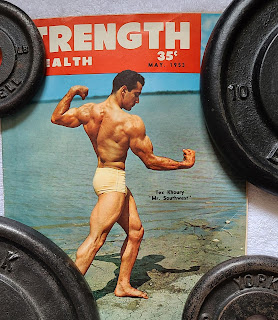
     The Spring of 1953 was a significant time in America.  Dwight Eisenhower was several months into his presidency.  The New York Yankees were embarking on what would be their fifth consecutive world championship.  And in May of that year, Strength and Health magazine would put out an issue that that would have to rank among the very best ever published.

     A casual glance at the Table of Contents provides a glimpse of the vast amount of useful information contained within the pages of this particular issue.  “Training for the Squat Clean and Press,” “Basic Exercises are Musts,” “Improve Your Pressing Power,” are just a few of the gems offered for the perusal of the readers of Bob Hoffman’s flagship magazine.  My personal favorite article was written by John Grimek, “Secrets That Bring Success.”  

     In his article, Mr. Grimek makes it very clear that there are no secrets to lifting and building muscle, per se.  There are no secret exercises or training routines.  But there are, indeed, “secrets” when it comes to making progress and getting results.  Mr. Grimek mentions three secrets.  Persistence, Exercise Knowledge, and Mental Aspects of exercise.  “If ever there were any secrets in this game, there you have the three essentials, the application of which may mean the difference between success and failure.”

     Persistence is something that I’ve written about before.  Back in October 2016 I wrote an article titled “The Power of Persistence in Training.”  Persistence is one of the best qualities that any lifter can possess.  Especially for those just starting out in the Iron Game.  Progressive effort and hard work are crucial, yet at the same time it is important to recognize the signs of staleness, and to know when it is time to give your body time to recuperate.  This is especially important for drug-free lifters.

     “The knowledge of exercise properly applied” can have several meanings.  Applying one’s knowledge means to know your body and what works for you and, more importantly, what doesn’t.  Nobody knows your body like you do.  This is why it is so important to not try to imitate or copy other lifters.  Exercises or programs that work for some people may not necessarily work for you.  Determining the most effective training method is crucial for anyone who works out.  However, it is especially important to recognize when enough is enough and avoid overtraining.  Again, as drug-free lifters, we must avoid doing too much.  Sometimes it’s wiser to train smarter, not harder.  

     The last secret, “mental attitude,” is the least understood of the three mentioned in the original article from 1953.  It is often considered unimportant to most lifters, and therefore it is often overlooked by many people who would otherwise benefit from such advice.

     “If your mental attitude is definite and cheery, success can be achieved faster and with greater certainty than if your outlook is pessimistic and dull.”  I don’t think that Mr. Grimek meant that we should walk around the gym with a perpetual smile and whistling a happy tune all the time, but you should definitely be optimistic and expect success.  Naturally, it’s easier to be optimistic when your training is going well.  This is where persistence and a well-planned routine will be of great benefit.  When your workouts are going well, then it should be easy to have a positive mental attitude.     

     “Keep in mind your goal and always aim to achieve the pinnacle of success.”  In other words, keep your eyes on the prize.  Don’t lose sight of the reason you’re hoisting the steel.  Are you looking to gain muscle mass?  Are you trying to increase your lifts?  Never forget what you’re trying to accomplish.  Picture yourself being successful.  Then put forth the physical effort to achieve your goals.

     Obviously, your goals have to be realistic.  And just as obviously, as drug-free lifters, we have to be sensible.  Don’t try to emulate some steroid-bloated freak that you saw on Youtube.  If you are currently capable of a 300 Lb squat, it would be foolish to focus on 600 Lbs initially.  Work your way up to setting- and achieving- more reasonable goals.  Try to work up to 350 Lbs, then set your sights on 400 Lbs, and continue to keep your goals manageable.  It may sound trite, but slow and steady wins the race.  By setting small, realistic goals, you will be able to make consistent progress whie at the same time staying focused on the bigger picture.  As you keep working towards your goals, your confidence will increase and your chances of success will greatly improve.  Ambitious goals, combined with hard work, will keep you forging ahead and provide you with stronger motivation.  

     Towards the end of the article, the Monarch of Muscledom gave some timeless advice.  “Let me assure you, outside of the qualities I mentioned earlier in the article, there aren’t any super-secret exercises to produce miraculous results overnight.  One thing is true however, certain exercises are more favorable to some than others, primarily due to leverage and structure, but anything more than that is self-inflicted.”

     Yes, there are secrets in the Iron Game, but they don’t come in the form of a particular exercise or new piece of equipment.  Rather, it means that you must apply your knowledge to your advantage.  “Let your mental attitude be a force towards success and achievement.  It can be yours if you WANT to succeed.  Wise advice from the most legendary Iron Game figure of the twentieth century. 


Read More »

Thursday, February 17, 2022

My First Set of Weights - By Jim Duggan


  The Summer of 1976 was a special time for me, and the United States of America.  On July 4th, America celebrated its bicentennial, and I celebrated my twelfth birthday a couple weeks later on July 20th.  Something else would take place that Summer which would have a lasting impact on my life.

     On July 17th, the Summer Olympics would take place in Montreal, Canada.  It was the first Olympiad that I would take an active interest in watching, and there was a lot to see.  Nadia Comaneci dominated gymnastics, Bruce Jenner won the decathlon, and the American basketball team won the gold medal, after having been cheated by the Russians four years earlier.      

     But the event that stood out for me that Summer was the Weightlifting.  Each night, a different weight class would be highlighted.  And while the American team struggled, there was a lot of great lifting to get excited about.  Some of the dominant performances in the heavier classes left an impression on me that remains to this day.  

     It was while viewing the heavy classes that I was bitten by “the Iron Bug.”  I just couldn’t get over the fact that such powerful men walked the earth.  Can you imagine being twelve years old and seeing these athletes hoist over 500 Lbs overhead?  As the television announcers proclaimed, these were the strongest men in the world.  And I wanted to be a part of it.  

     There was just one problem.  I needed a set of weights.  The good news was that the local sporting goods store sold a 110 Lb set for about thirty dollars.  The bad news was that I did not have the money to pay for it, but there was hope for me.  That Summer, I had begun mowing the lawn of our elderly neighbor, Mrs. Johnson, for six dollars per week.  There was light- and weights- at the end of the tunnel.

     Fortunately- or unfortunately, depending on your point of view- Hurricane Belle struck Long Island about a week after the Olympics ended.  It enabled me to earn extra money from Mrs. Johnson, cleaning her yard from the storm damage left behind.  Additionally, since I had been a big help to my parents, it was decided that I would only have to come up with half the price of the weights.  I was in business!

     I’ll never forget the day we drove home from the store.  The five foot bar ( which looked even longer!), the two dumbbell bars, and, of course, the large box containing the various plates.  I didn’t realize it at the time, but my Dad carried the large box into the house by himself.  No dolly, or hand truck.  I was too young to realize how impressive that was.

     From that very first day in August1976, until the day I joined Bruno’s seven years later, my training took place in the enclosed porch of my parents’ house.  It was sweltering during the Summer, and during the Winter I froze, but I didn’t care.  I just wanted to lift.  Even if I didn’t know what I was doing, I wanted to lift.  And, with my Dad’s encouragement, I rarely missed a workout.  “Just keep lifting” he would say to me.

     As I got older and stronger, we would drive to the nearest place that sold gym equipment and bought additional weights, not to mention benches and various attachments.  Eventually, the porch of our house resembled a small gym.  But rather than get upset, my Dad would still encourage me.  “Just keep lifting.”

     After I joined Bruno’s, the weights in the house kind of gathered dust over the years.  Bruno’s, The All Natural Gym, and Iron Island are the three commercial gyms I’ve belonged to over the years.  During that time, I’ve competed in Powerlifting and Strongman competitions.  I’ve met and lifted with some of the legends of the Iron Game, but I’ll always remember my introduction to the world of weights and lifting.  And I’ll never forget how it all began.

     Two weeks ago, on January 29th, my Dad passed away suddenly.  No matter how you prepare for that awful day, it still hits you like a tidal wave.  It’s been said that losing someone you love can seem to diminish your own existence.  Perhaps.  But there will always be precious memories from which to draw strength.

     One particular memory of my Dad has been documented on this website by Bob Whelan.  It was in the article “Training and Eating in the Big Apple.”  On July 20, 1996 I turned 32 years old.  That night, “Maximum” Bob, Drew Israel, Howard Menkes, and myself went to the famous Peter Luger Steakhouse, in Williamsburg, Brooklyn.  While the four of us were eating, I happened to look up and there was my Dad!  He was in uniform and on duty ( his firehouse was a few blocks away from the restaurant).  He took the time to stop by and surprise me on my birthday.  He later confessed that he also wanted to see just how much steak the four of us could “put away.”  I don’t think he was disappointed.  But I sure was happy to see him.  It remains one of my favorite birthdays.

     Over the years, I’ve admired many Iron Game figures.  Bruno Sammartino, John Grimek, Bruce Wilhelm, Jon Kolb to name a few.  But the man who has had the greatest and most enduring influence on me is my Dad.  He is also the person who made it all possible. At his funeral, I concluded my eulogy with a simple statement:  He was a hell of a man.


Read More »

Monday, January 3, 2022

Training Essentials - By Jim Duggan

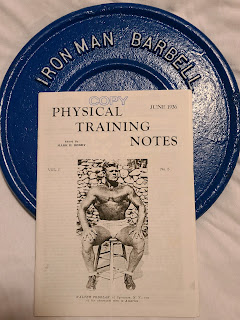
In the June 1936 issue of Physical Training Notes, Mark Berry wrote an article titled “A Talk

On Training Essentials” which appeared on the second page. Anytime I see the word

“essential” written anywhere I take notice. Naturally, a gifted wordsmith realizes that certain

words and phrases will attract the attention of readers. The old “muscle magazines” are

famous – or infamous – for using words like “Bombing,” “Blitzing,” “Blasting,” etc. in order to

entice prospective muscle-heads. Even today, certain phrases designed to grab your attention

and cause you to read further, as well as advertise some of their bogus products. The bottom

line is, words are powerful tools, especially in the hands of a skilled writer ( or someone who

writes for mainstream muscle magazines!).


Mark H. Berry published his Physical Training Notes monthly for approximately one year.

And while he did actually advertise barbells and other equipment, the information he

disseminated during the short run of his magazine was useful, pertinent, and has stood the test

of time for the most part. Other articles in this particular issue include “Towards Lifting

Proficiency,” “Dietetic Absurdities,” as well as several photos of a young John Grimek.

Anyway, back to “Training Essentials,” the prime essential is that trainees “put forth some

effort. He must train with religious regularity.” Regular training is an absolute must if you want

to make progress, no matter what your goals may be. This was true 85 years ago, and it is true

today.


Mr. Berry continues by saying “There are literally hundreds who regularly undertake barbell

exercises who do not persist for longer than a few weeks.” As we embark upon a new year,

how many people will make a resolution to start working out only to fall by the wayside within

aa few weeks? In addition to being persistent, you must also have the discipline and

determination to stick to your workouts and accomplish what you set out to do. Missing

workouts, skipping meals, or not training hard will inevitably lead to failure.

Another valid point that is mentioned in the article is the importance of following a workout

routine designed for the entire body. Apparently, the foolish idea of training individual

bodyparts ( Chest Day, Arm Day, etc.) was around even back in the 1930s. What nonsense! “I

am a believer in the harmonious development of the entire body.” The article goes on to say

that many trainees have increased the size of their arms as a direct result of heavy leg work. In

other words, forget about endlessly pumping your arms and instead, hit the squat rack. Heavy

Squats will add size to your entire body, including your arms. Many years ago, when I was

training at Bruno’s, Larry Licandro once devoted an entire Summer to just three exercises:

Squats, Bench Presses, and Deadlifts. No other movements except for the three powerlifts. He

did nothing else. Guess what happened? By the end of the Summer he had gained twenty

pounds ( from 210 to 230 ). A twenty pound increase in bodyweight without having done a

single curl!


Mr. Berry refers to another training concept that has been very effective over the years:

High Rep Squats. “The Deep Knee Bend has been found most valuable as one of the training

methods; nothing less than twenty repetitions should be employed. He even goes on to

suggest doing more. Forty, fifty, or even more reps! Can you imagine going to the gym with

the goal of doing a set of fifty Squats? The mere thought is enough to scare off most people.

The most I’ve ever done is an all-out set of 30 reps, years ago at Iron Island. I thought I was

going to die. I can’t imagine doing fifty. However, the important thing is that even back in

1936, the importance of high-rep Squatting insofar as it relates to gaining muscular size was

widely recognized and accepted . Over the years, many diverse authorities have confirmed the

effectiveness of doing sets of high-rep Squats to failure. Dr. Ken Leistner, J.C. Hise, Peary Rader,

John McCallum are but a few of the proponents of doing Squats for high repetitions.

There is another salient point in the article, and it is the underlying principle of lifting

weights. It is the law of progression. Whether it’s adding weight to the bar, or increasing the

repetitions, the whole idea behind progressive resistance training is, indeed, to make progress.

Sometimes you simply have to force yourself to add weight to the bar. “It is wise for the more

experienced culturist to adopt the progressive system when he reaches that bug-bear of all

weight enthusiasts- the sticking point.” Is there any lifter who has NOT experienced the

dreaded sticking point or plateau? The occasional sticking point is inevitable, especially for

drug-free trainees. If it becomes increasingly difficult to continue to add weight, then try

increasing the repetitions, even if means lowering the weight on the bar. “Sooner or later, you

will be enabled to progress on poundage and through dropping down on repetitions be capable

of continuing to progress.” Many times it’s easier said than done, but we must always keep our

eyes on the prize: Poundage Progression.


Effort and Regularity.

Persistency.

Whole Body Workouts.

High Rep Squats.

Poundage Progression.

These five “essentials” are the key to any effective strength training program. They’ve been

building strength for a long time, and will continue to do so for many years to come.


Read More »

Wednesday, December 1, 2021

Just Keep Training - By Jim Duggan

Back in the Spring of 1995, I had the good fortune to attend the Club Industry Trade Show in New York City.  Basically, It was a convention of vendors and distributors of exercise equipment. Most of the well known, as well as the lesser known, equipment manufacturers were in attendance. I attended the show with Drew Israel and other members of Iron Island Gym.  

     Naturally,Nautilus, Hammer Strength, MedEx, and Southern Exercise Equipment Were popular exhibits. For anyone who loved the train, and who appreciated various strength building modalities, seeing all the latest machines and equipment was like going to strength training heaven. This was the main reason for wanting to attend. Another reason was that there would be any number of “famous spokespersons” representing some of the equipment manufacturers.

     Some companies used former bodybuilders from the 1970s and 1980s in the hope of  attracting potential customers. For some reason, seeing some chemically enhanced freak would not inspire me to purchase anything. Other companies used former powerlifting champions from the same era, hoping to appeal to the “lifting crowd.”  And, indeed, there were at least two former World’s Strongest Man winners selling equipment and making themselves seen.

     While it was nice to see some of the legends from the past I got the feeling that they were there just to collect a paycheck,. In other words, they were just doing their jobs. Nothing more and a day's work. Of course, there were exceptions. Getting to meet the legendary “Big Jim” Flanagan from MedEx  was a privilege and a pleasure.  What an impressive man!  He was friendly, knowledgeable, and down-to-earth.  He took the time to discuss his machines without pressuring you. He loved to talk training, and it was quite evident that he was not there just to make a buck for himself.

     Another highlight of the day was meeting Bill Pearl, who won his first Mr. Universe title back in 1956. There is a reason why I distinguish men like Bill Pearl from current crop of glitter shorts wearing pumpers and posers.  Bodybuilders like Bill Pearl trained for size strength and health. His longevity in the Iron Game indicated that his way of training exemplified  the ideals of Physical Culture.  Additionally, when I met him he was nearly 65 years old, but he looked about twenty years younger.  At least.

     Mr Pearl was exceedingly friendly, in addition to being knowledgeable about the machines he represented. He actually had a complete line of machines from the company for which he was a spokesman in his home gym. He confided to us he couldn't endorse a product if he did not actually use it himself. Mr Pearl also took the time to answer questions about his legendary career, is early morning workouts ( he was famous for training at 3:00 AM ), as well as his current lifestyle.  Although nobody in our group was a “bodybuilder,” We were all impressed by his passion for lifting and training.  

     There was one thing he said that has stuck with me for many years. I had asked him for his “secret” for staying strong healthy and youthful at an age when most people are ready to retire.  His answer was simple and brief.  “Just keep training” was his response. At the time, I didn't understand the significance of his advice. I almost felt as if he were brushing me off, but he seemed too genuine to dispense superficial advice. “Just keep training.”  In time, I would begin to comprehend the meaning of what he told me. And it truly was a significant statement. What he meant was if you keep training and lifting, you will discover what exercises and routines work best for you. And by applying the knowledge accumulated over years of experience, you will indeed find the “secret.”  In other words, learn what works best for you and then keep applying it.

     Whenever I think of Mr. Pearl’s “secret advice,” I remember a picture hanging in my home. It is an autographed photo of Jack LaLanne.  The picture is from 2007, and I always think about what he wrote to me. “To my friend, James.  Keep up your workouts always.  Health and happiness always.  Jack LaLanne.”  

     “Keep up your workouts always” was what really hit home for me, as you can imagine. Whenever I have a day where my enthusiasm maybe lagging, I always think about the words that Jack LaLanne wrote for me.  And then I combine his words with Mr Pearl’s pithy advice. I don't think anybody could go wrong following use two pieces of sage advice. They have certainly helped me over the years. 

     I am at an age now ( 57 years old ) where, if someone were to ask me for training advice, I would start with “Just keep training,” and “ Keep up your workouts always.” Naturally, I would give credit where credit is due and acknowledge the two legendary Iron Game figures who were kind enough to share their knowledge with me.  Lifting weights is an activity where we learn so much about ourselves, but sometimes it takes a few brief words of common sense to keep us focused.  I consider myself to be lucky to count myself among the countless number of people to benefit from the wisdom Bill Pearl and Jack LaLanne. Hopefully others will be inspired to keep lifting.


Read More »

Friday, November 5, 2021

We Must Have Strength To Live - By Jim Duggan

This is the title of Bob Hoffman's editorial in the November 1946 issue of Strength and Health magazine. While looking through the pages of this classic edition, the title of the Editorial immediately caught my attention. Anyone who loves strength would be drawn to such a title. The opening sentence of Mr. Hoffman's editorial is even better: "Strength and health are the two most important things in the world. Without them life is not worth having." While some people may not completely agree with this statement, the importance of being strong and healthy cannot be disputed. As Dan Lurie famously said "Health is your greatest wealth."

All of us who "hoist the steel" have an appreciation for strength and, more importantly, the process by which strength is developed. The process of getting stronger- the workouts, dedication, and sacrifice- is truly a labor of love. How can anyone lift for decades and not love it?

I remember a conversation I had with a "personal trainer" which took place back in 1996. This guy was affiliated with the "Super-Slow" training philosophy, which was popular at the time. Now, I'm not going to get into a discussion of the merits (if any) of super-slow training, or whatever they call it today. But I'll never forget something this guy said to me. Actually, it was a question that he had asked me. "Do you actually like to train?" At first I thought he may have been kidding, but he was totally serious. "I absolutely love lifting and working out!" was my response. The look of surprise on his face indicated to me that he himself most certainly did NOT enjoy lifting. This told me all I needed to know about him as a "trainer." In my opinion, he wasn't worth a damn as a personal trainer. To him, it was just a job, a way to make money. Those were my thoughts twenty-five years ago, and I have not wavered in my opinion all these years later.

If you absolutely must hire a personal trainer, in addition to seeking out someone who is qualified by virtue of an academic background in exercise kinesiology, or physiology, try to find someone who has a passion for working out. How can anyone who trains other people expect their clients to embrace the ideals of Physical Culture if they are only in it for a paycheck. Avoid "trainers" who don't love the Iron just as you would avoid a trainer who is a steroid-bloated druggie. Neither of these categories of Physical instructors is worth your time or money.

The most successful strength coaches and trainers LOVE to "sling the Iron." I first began lifting weights as a teenager, and I love more at the age of 57 than I ever have. Whenever I'm asked if I still enjoy working out after all these years, I always flash back to one of my favorite movies, "Patton," the story of legendary American general George Patton. I always think of the scene during the battle of the Ardennes. As Patton surveys the battlefield, he states:"I love it. God help me I do love it so. I love it more than my life." Now, I don't expect everyone who lifts to have such strong feelings, but I think you get my point. If you cannot get excited about lifting, and getting stronger and healthier, then why bother going to the gym? Go play golf instead.

Later in the Editorial, Mr. Hoffman makes the additional statement that strength is internal as well as external. Basically, when when you develop your muscles on the outside of your body, you also develop and improvenall the muscles,processes, organs, and glands on the inside of the body. The only way to strengthen the internal organs and processes is through exercise.

"When you start out to make yourself stronger with weight training, when you constantly endeavor to put forth more effort through progressive training, you are teaching or conditioning the internal organs to work with greater strength and efficiency." Quite a statement, but what it means is that when you lift weights, you are not only building physical strength, you are also building super health and mental strength as well.

Getting bigger and stronger requires self-discipline, courage, and determination. These admirable traits will benefit anyone wishing to improve his/her life. However, in your quest for size and strength, never lose sight of the importance of improving your health. "To become super-strong, you must become super-healthy." Another excellent quote.

"Strong men and women are strong all over, inside and out." Most people who adhere to the drug-free lifestyle are already aware of this simple fact, stated so eloquently by the "Father of American Weightlifting," 75 years ago this month. And since the anniversary of Bob Hoffman's birthday is in a few days ( November 9, 1898), it's only fitting that we benefit from his words of wisdom.

Read More »

Sunday, October 31, 2021

Priorities of Strength - By RJ Hicks: MS, CSCS

One of the major strength training topics Bob and I talk about is intensity. Intensity is defined as the amount of work done per unit of time. I have been mentored by Bob for many years and have had his personal definition of increasing Intensity ingrained into me. Bob believes there four ways to increase intensity. Poundage progression or adding weight to the bar. Training with sets to muscular failure, forcing the muscles to do more work in one set. Reducing the amount of rest you take between sets, allowing you to do more work in less time. Lastly, using good form during your training. This forces the muscles to perform more of the work, rather than using momentum and gravity to assist with moving the resistance. All of these methods will increase intensity, but it is essential that you train with progressive resistance in good form as it is the backbone of all successful strength training programs.

Sets to Failure There are many professionals in the field who believe training intensely only means lifting a weight until momentary muscular failure. They forget all about poundage progression and believe as long as they train with a high level of effort to failure, they will maximize their muscular size and strength. There are training facilities across the U.S. that utilize training to failure as their main goal for their clients’ workouts. They book appointments in 30-minute blocks and use high end strength training machines so the clients can safely train to failure in all of their exercises. This is both a great business plan for business owner and for the client. The business owner can train twice as many clients in a day and double their profit. While, the client can receive an extremely hard work-out and only sacrifice 30 minutes of their day.

There is zero doubt that intensity is one variable to maximizing muscular size and strength, however it is the way some trainer’s priorities the different methods of raising intensity that detract from the goal of maximizing strength. Training to failure can be a very beneficial way to train, especially for athletes whose sport doesn’t involve a barbell. It is a productive way to train, because it requires fewer work sets to be done. Usually, training to failure only requires one hard all-out work set with a moderate rep range as opposed to performing three to four work sets of a specific exercise. It is time efficient because less work sets are required to produce the amount of muscular overload needed to increase muscular size and strength. Bob and I both agree training to failure can be a great way to train, IF it is done progressively.

You can go to failure with light weights all you want, but if you never increase the weight, you’ll progress little. Going to failure with light weights has the same pitfall that training with only calisthenics present. It deemphasizes strength (the amount of muscular force you can produce) and emphasizes muscular endurance (the amount of repeated submaximal force your muscles can reproduce over an extended period of time). If they weight is too light your muscles will not improve the amount of muscular force they can produce. You will only get better at lifting light weights to failure. If this wasn’t the case there would be no need for weights and everyone would just use calisthenics. You can make training to failure a productive element of your training, but without poundage progression your ability to maximize strength will be limited.

For most of Bob’s years competing in powerlifting he never focused on training to failure and only focused on trying to get the goal for each work set. Failure happened by accident, but was never thought of as the goal. It was a natural byproduct of training hard and heavy. It wasn’t until later in his training years after reading “Heavy Duty” that he started to alter his training. The main exercises (bench, squat, deadlift, incline press and behind the neck presses) were still trained in a pyramid style fashion, but the supplementary exercises were done in a high intensity training manor. He knew it doesn’t really matter if you go to failure, it just makes you do less sets.

Many of the Oldtimers never trained to failure either and made tremendous gains in muscular size and strength. Most of the training courses advertised in the early “Strength and Health” and “Muscular Development” magazines used a double progressive system, meaning the reps were increased first and then at a certain point the weight was increased. Take the arm curl as an example on a routine that trains three days per week. The athlete would choose a weight which they could complete the arm curl at least ten times, and for four exercise days it is repeated for the same number. Then it would be tried for 11 times for four exercise days. Then 12 times for four exercise days until the athlete is able to repeat the arm curl twenty times for four exercise days. At this point five pounds would be added and the process is repeated until another five pounds is added, and so on. The old-timers built up to handling large weights on the basic exercises through consistently prioritizing POUNDAGE PROGRESSION. They didn’t worry about training to muscular failure, burn-out sets or creating large amounts of fatigue in their muscles.

Rest Between Sets Reducing the amount of rest between work sets is another great way to increase intensity. The less sitting around you do the more challenging each exercise will feel. Your heart rate will stay at a higher pace as you continue to lift weights not fully recovered. I think reducing rest between sets is great way to increase the intensity of your workout, but if you get too carried away with limited rest it can negatively affect your muscular strength development.

There are still trainers that like to utilize a method of reducing rest called “the rush factor”. I know people who swear by this method and whose workouts only last 15 to 20 minutes. It is a non-stop workout where you move from one exercise to the next with no rest in between. Some motivated enthusiast even run between exercises to further reduce their resting time. Using the rush factor brings cardiovascular benefit to the workout and certainly raises the intensity level, but it is not a priority in maximizing strength. There are no physiological strength benefits from putting your body into metabolic shock. Vomiting and rolling around the floor at the end of your workout looks hardcore, but does nothing to build greater strength. When you severely decrease the amount of rest you take between sets you actually hurt your ability to maximize your strength. Without rest your muscles are unable to produce enough force to optimally provide overload to the muscles. You get a watered-down version of strength training most times, because your cardiovascular system ends up holding you back. That is why powerlifters take plenty of rest between their heavy work sets.

The truth is reducing the amount of rest you take between sets plays no part to increasing your muscular strength. You can rest as long as you want between exercises and make fantastic strength gains, as long as you are focusing on poundage progression. Paul Anderson used to rest for several hours between exercises, while he trained. He would do some heavy squats, then go inside to eat and relax, then he would come back outside an hour or two later and do some heavy military presses. As long as you get all of your training done within the day, it really doesn’t matter how much rest you are taking if you are looking to just increase your strength.

For a business this is not an optimal way to train clients, because you are charging them by the hour. Nobody wants their money wasted by sitting around for three to four minutes between every work set. Too much rest also takes away from the overall workout intensity and can play mental games on clients. One way Bob taught me to strategical build in rest between work sets is to add in tinkering exercises between the basic compound exercises. An example of this would be to go from the bench press to the seated row to an abdominal exercise. You may be only resting 30 seconds between each exercise, but there is a three to four minutes rest before you return to do another set of the bench press or seated row. This way you are increasing the number of exercises done in the hour, while prioritizing lifting the heaviest weight that you can.

Good Form Good form is the third variable to increase the intensity of a workout. Good form is a given and always expected to be used during training. Good form forces your muscles to work more to contract against a certain load, raising its intensity. Good form means using a safe full range of motion and not allowing momentum or gravity to assist in moving the weight. Good form is always needed and doesn’t even need mentioning, however, there are some who take good form to an extreme and train with a very slow speed of motion.

Slow training was a method of performing repetitions that was popularized in the 90s and is still imbedded in many trainers’ philosophies today. The idea behind it is to move the weight so slowly that the momentum is nearly all eliminated from the movement and that every repetition can mirror the next to accurately measure progress. The most popular repetition cadences seen from gym that follow this philosophy are 10/10 rep speed (10 second raising the weight and 10 seconds lowering the weight). 10/5, 8/8 and 6/6 are other popular cadences, but a 10/10 rep speed is the most common.

There are advantages to using a slow speed in some instances and it is without a doubt a workout intensifier technique. A slower rep speed compared to a fast rep speed can be safer since less force is imposed on the surrounding muscles, ligaments and tendons. A slower rep speed forces the muscles to stay under load and contract longer than a fast rep speed does. The problem arises when trainers overemphasize the form of exercise, but decrease the speed of movement

The disadvantage of the normal way slow training is administered when it comes to maximizing strength is that it prioritizes rep speed over poundage progression. Slow training dissuades the use of heavy weight, due to the strict rep rules. You can get strong in the beginning using slow training, but once the weight gets heavy you can’t finish the rep. It is against the rules to pick up speed to finish the rep, you are constricted to lifting at a specific cadence. This makes it very difficult to move heavy weight. The weight ends up holding you back from getting stronger, because you cannot push through the mid-range of the rep. The only gains you’ll make over a few months is a couple of 2.5-pound plates.

Drew Israel, a frequent guest on Bob Whelan’s “Natural Strength Night” had a very similar experience with slow training. Drew used slow training for two years and found his strength was diminishing from what his previous training built. He noticed a loss in overall size and strength when he experimented going back and forth between using normal speed training and slow training. He did note that slow training can still be beneficial to beginners or if you have injuries that are bothering you, since it could allow you to train on exercises that your body couldn’t tolerate at normal speeds.

If you like slow training than do it. There is nothing wrong with slow training and it is a great way to get a challenging workout in. Some trainers will have you performing repetitions between two and three minutes, which is a killer cardiovascular wise. There are ways to add it into your training as a specific theme for the day as a form of variety or on a specific movement that causes irritation. One of my clients suffered from a shoulder impingement for years and was unable to do any consistent overhead pressing. I had him train the overhead press for several months using a 10/10 speed which allowed him to get stronger and remain pain free. I prioritized poundage progression by setting the goal at three reps and not being overly critical on the timing/form. his way he was still training in the anaerobic energy system since no set lasted longer than 60 seconds. If he had to pick up speed naturally on the last rep to finish, so be it. The speed was still slow enough not to cause any pain.

Poundage Progression Poundage progression is the fourth variable, yet equally important as good form when it comes to increasing intensity. Without poundage progression none of the other three methods will maximize your muscular size and strength. The principle of poundage progression goes all the way back to the late 1800 in the United States when physical culture really started to take off. Everyone in the know knew poundage progression was the main focus for developing strength. That’s why tools like the adjustable barbell are so valuable to the Iron Game, because it was the first tool of its kind to easily allow users to incrementally add more weight. Every barbell and dumbbell course published during early to mid-1900s was built around the premise of continuously adding weight to the bar overtime. Every authority in the field agreed that training with tools that allowed you to progressively add resistance were far superior compared to calisthenics. It was even the main method of muscular rehabilitation during World War II. Poundage progression is the key-ingredient that makes different training routines work. It doesn’t matter if you use machines or free-weights, high reps or low reps, one set or multiple sets, or prefer to do Olympic lifts over bodybuilding movements. The key is that no matter what you are doing if you systematically implement a method of adding weight overtime then you will get stronger.

To force a muscle to grow larger and stronger you must provide muscular overload. This occurs when a muscle is driven to work beyond what is comfortable. Training progressively does this by increasing the weight against which the muscles develop tension. The heavier weight the muscles are able develop tension under and create movement the stronger the muscles become. This is the best intensity variable to use to increase the total work output during a training session.

There is no one best progression scheme for anyone or for any one specific lift. There are many ways to set up a progression scheme best off of your preferences and instincts. The main rule is to have a set/rep goal and to add a little weight when you are no longer straining to reach it. The exact load to increase by varies amongst individual and is base on the current ability of the muscle’s groups being trained. The key is once you have a systematic progressive scheme in place is to stick with it for several weeks before switching to another.

All of these ways of increasing intensity can be thought of as a It balancing act. The more emphasis you put on any of the four ways of increasing intensity, the more you must take away from the other variables. How you prioritize each variable is ultimately up to your preference and goal. If you prioritize poundage progression you must decrease the emphasizes on reducing rest. If you prioritize limited rest between exercises, you must decrease the amount of weight you are handling. Each variable of increasing intensity comes with its own benefits and can be made to work as long as some form of increasing resistance is systematically applied. As Bob has stated numerous times “poundage progression is the unifying factor in all successful training programs”.
Read More »

Friday, October 1, 2021

Training Liberation or Wisdom From Bradley Steiner - By Jim Duggan

Over the years, I've written articles based on material obtained from old issues of Strength and Health magazine, usually from the 1930s and 1940s. I've always believed that quality training information is timeless, and that we can all benefit from the wisdom of the past. Naturally, common sense training advice is not limited to a certain period of time. I recently looked through an old issue of Muscular Development from August 1988. What I found interesting about this magazine was that this issue was definitely NOT before my time. Indeed, in 1988 I was 24 years old, and had been competing in Powerlifting for several years. Additionally, by 1988, Bob Hoffman had been dead for several years, and John Grimek had retired. But guess what? There was still useful, pertinent training advice written by some of the most prolific Iron Game authors. A casual glance at the contributing authors of this edition of MD shows names like Dr. Ken Leistner, Jan Dellinger, and Bradley Steiner. Any list of the most talented Iron Game writers off all-time would include these three gentlemen. Incidentally, I would also include "Maximum" Bob Whelan, and Brooks Kubik to this list as well. 

Back to the August 1988 edition of Muscular Development. There is an article titled "The Liberated Trainee," written by Bradley Steiner. Mr. Steiner passed away almost a year ago. He has been rightfully described as one of the greatest strength training writers ever. He always advocated sensible training with an emphasis on hard work, determination, and desire being the keys to success. And he was against the use of steroids and PEDs. Many people claim to be against drugs, but Mr.Steiner actually had the guts to speak out against them. Many people pay lip service to being against steroids, but people like Brad Steiner and Larry "Bruno" Licandro didn't just talk the talk. They walked the walk and fought the scourge of steroids. In this particular article, Mr.Steiner details the challenges faced by the vast majority of trainees. He refers to these people as "hardgainers" but he could very easily be referring to those lifters who are drug-free. He brings up a number of valid points which i would like to share.

"The saddest thing is being a hardgainer and quitting because you feel that it is useless to expect satisfactory gains." If you are a "hardgainer," or if you are drug-free, there is absolutely no reason to quit if gains are coming slowly. You can build impressive size and strength without the use of drugs if you are willing to work hard. In addition to working hard, you must also work smarter. Do not blindly follow follow the routines of the so-called champions. Most, if not all, of these "champions" are steroid-bloated druggies. Learn to listen to your body and learn what works for you. "Hardgainers require very limited programs and carefully controlled schedules of exercises." 

Mr.Steiner hit the nail right on the head with this statement. Training bodyparts, with endless sets on a six-day-per-week program is a sure way to overtraining, burn out, and injury. Many new trainees simply can't believe that you can make great gains by lifting only two, or at most three, days per week. "Start thinking in terms of simple, brief, and intensive workouts." Another solid statement. Squats and Deadlifts are the bedrock upon which the most effective strength-training programs are built. Developing the legs, hips, and lower back will build great all-around strength. In other words, pumping your arms and "pecs" may build showy beach muscles, but it will do little in terms of building overall body piwer. "A hardgainer's program should be built around Squats, Presses, Deadlifts, and Bent-over Rows." Truer words were never spoken. Naturally, you can make substitutions based on leverages, age, past injuries, etc., but if you wish to build strength then you must include some form of Overhead Press, a heavy pulling movement, and leg work. Concentration curls, triceps pushdowns, and other useless exercises simply will not get it done. 

"Do not organize a drawn-out program of training if you are a hardgainer." Another spot-on observation. If you are drug-free your body will not be able to recover from long, drawn-out workouts. A few hard, heavy sets on the basics is all you need to get stronger. If you train at a commercial gym and suggested abbreviated training to the vast thong of pumpers and toners you would probably be considered some sort of weirdo. But you probably walk into the gym, perform a few heavy sets of Deadlifts, Presses, Rows and be finished while the toners are still sitting around and texting their friends. "Don't grind away at any exercise to the point where you're ready for a stretcher." A common sense piece of advice. 

As drug-free Lifters, we only have so much energy to expend in any given workout. Even on a wonderful exercise like the Deadlift, you can reach a point of diminishing returns. Don't do too many sets of any movement, no matter how strong you may feel. "Be sure that heavier weights and not more exercise is your main goal." Heavier weights. Poundage progression. Adding weight to the bar. The key point of progressive resistance training is increasing the resistance. If you're not adding weight to the bar, then performing additional sets will not help. It may even hurt. Poundage progression is the "since qua non" of any strength training program, and don't let anyone tell you differently. "Avoid any tendency to train with any degree of frequency that forbids rest days between hard sessions." This was mentioned before. Give yourself adequate rest between workouts. By rest days, I mean days of NO lifting whatsoever. 

How many rest days between workouts? Again, everyone is different. Some people, due to age, work sschedule, etc., require more rest than others. Listen to your body. Nobody knows you like you do. If you haven't sufficiently recovered from your last workout, give yourself an extra day it two. Your body will thank you. " Discouragement is your worst enemy." If you love to lift, then it will be easy to maintain your enthusiasm. Many hardgainers have been able to develop great strength. You can too. Don't allow the occasional bad workout to deter you from achieving your goals. There is one other point that Mr. Steiner mentions throughout the article, and I will conclude this aarticle with his words regarding steroids" "Never use them!"
Read More »

Thursday, September 23, 2021

New Remote Training Products and Prices! - By Bob Whelan

Check-out the new options and prices for remote training and consultations! Scroll to the bottom of the landing page.  CLICK HERE FOR INFO  

Read More »

Monday, September 13, 2021

A Tribute Workout - By Jim Duggan

Every year, as the Summer winds down, most people look forward to the upcoming Autumn season. The end of August usually brings the anticipation of Labor Day along with the accompanying return to school, work, and Fall weather. However, for members of the Fire Service and especially for members of the NY City Fire Dept., it can be a difficult and challenging time. The anniversary of the 9/11 attacks bring feelings of dread and sadness as we remember the nearly 3,000 Americans murdered on that tragic day, including 23 NYPD Officers, 37 PAPD Officers, and of course the 343 members of the FDNY who made the supreme sacrifice. 

Any anniversary of a significant event causes us to reflect more than usual. "Where were we when it happened?" is a question we often ask ourselves. Time marches on, as it always does. Memories fade, as they sometimes do, which, in a way is a good thing. If we had to live with the acute pain of every past historical event that ever happened, it would be a depressing existence. But as we look past the pain and sadness, we remember the bravery, dedication and sacrifice of those we lost twenty years ago.
 
Every year, throughout the country, there are tributes, memorials, and ceremonies to mark the anniversary and renew our promise that "We will never forget!" There are also memorial events of a physical nature- 5k runs to honor the memory of Firefighter Steven Siller who, in full firefighting gear, ran through the Brooklyn Battery Tunnel that day to join his unit where he lost his life while saving others. There also memorial Stair Climbs to honor the hundreds of firefighters who ascended the stairs of both towers in an attempt to save as many trapped victims as possible. 

This year, a few days before the anniversary, I decided to honor the memory of my fellow firefighters who were lost that day, with a physical challenge. I've never been much of a runner ( if I were a car, you might say I was build for comfort, not speed), and since I no longer belong to a commercial gym, I no longer have access to a Stairmaster. I decided that a Deadlift Challenge would be the most appropriate means of honoring the 343 fallen heroes, especially considering my love for all things strength-related. I came up with a very simple, yet brutal, workout challenge: 343 Lbs. for 107 reps in one hour, using my special 2" thick-handled Trap Bar. The number "343" naturally represents the 343 FDNY members who were lost that day. The number "107" represents the company I was assigned to twenty years ago, Ladder Co. 107, in East New York, Brooklyn. I decided to complete my "workout" on Friday, September 10, since I would be at various remembrance ceremonies the following day. On the morning of the workout, I decided to weigh myself, and my bodyweight was 231 Lbs., which is significant since my current assignment is Engine Co. 231, in Brownsville, Brooklyn. Talk about coincidence. 

For the last month or so, I have been doing kettlebell deadlifts with the goal of reaching 107 reps in as short amount of time as possible. I was introduced to this type of training by my good friend and fellow strength fanatic, Steve Weiner, and I've found it to be intense, and effective. A week before, I did 107 reps with two 144 Lb. kettlebells in 36 minutes, while standing on a two-inch block. However, 343 Lbs on a thick-handled trap bar would be a different story. On Friday, September 10th, at 2PM, I began my workout. I began with several singles, to warm up, and then I did sets of five until I hit 25 reps. At that point, I switched to triples, so that I wouldn't expend too much energy on each set. I kept going at a fairly regular pace until I hit 85. It was at this time that I noticed that I had torn a callus on one of my fingers. Thank you, thick-handled trap bar! I also knew that there was NO way I was going to let that stop me. From 85 onward, I alternated between triples and doubles until I reached my goal of 107 reps. Upon completing my final rep, I checked the time and was slightly disappointed that it had taken me slightly over an hour to complete my workout. I say "slightly" because I was happy that I was able to get through what turned out to be as grueling a workout as I can remember. To say I was sore the next day would be the understatement of the year. My entire body felt as if I had been run over by a truck. At our firehouse remembrance ceremony the following day, each time I performed a hand salute was a new adventure in soreness, as my entire body was aching. But I'm glad I did it. I would like to conclude this article by remembering those we lost twenty years ago. May we never forget. May we also never forget the men and women of our armed Forces who serve and protect our great nation.
Read More »

Wednesday, September 8, 2021

Remember the Goal of Strength Training - By RJ Hicks MS, CSCS

The goal of strength training is to train progressively with the most weight you can in perfect form. The weight must be challenging for you, depending on your specific repetition goal. When the weight is no longer heavy you add a little weight to keep the total weight challenging for you to lift. It is so simple, but misunderstood by many.

The only competition in the gym is between the lifter's past performance and their next performance. Each workout is a competition where the lifter strives to improve how much weight they are able to lift. It doesn’t matter what other lifters in the gym are doing, world records that have been achieved or what is displayed on social media. All that matters in strength training is whether or not a lifter is able to add weight to the barbell or machine they are handling over time.

However, nobody said you add weight every time you train or at all, unless you are physically able to in good form when the goal is reached. You cannot just add five pounds each workout. It is unrealistic for the body to be able to adapt to this long term. If it was possible everyone would be benching over five hundred pounds after a few years of training.

Poundage progression is based off of your individual performance not based off of time. You can only add weight when you earn it, by surpassing the training goal for each specific lift. Training with long cycles doesn’t make sense if you are a natural trainee. You cannot pre-plan when to add weight unless you are starting so light in weight that you waste most of the year training sub maximally. Drug users can pre-plan poundage progress, because the training cycles work in conjunction with the amount and type of anabolic drugs they are taking.

The key for natural trainees is to strive for poundage progression. Do the best you can, handling the heaviest weight you can for the proper repetition range. You may hit seven repetitions two weeks in a row, six the next week and seven the fourth, but it doesn’t matter. Pat yourself on the back if you gave it your best effort and move on to the next set or the next exercise.  As long as you are TRYING to continue to lift more weight you are doing everything you can to get stronger. Eventually you will surpass seven repetitions if you stay with the weight and continue to train hard, eat the proper nutrition and take plenty of rest.

Where many beginners go wrong is they get attached to a certain repetition range or scheme and allow themselves to become negative when they reach a sticking point in their training progression. There is no magic behind any repetition scheme, whether it is straight sets, descending sets, single sets etc. They are all just systems that guide poundage progression in your training. Once you are able to surpass the goal of the repetition scheme you know to add weight. You use the repetition scheme to assist you in the goal of adding weight, but the specific repetition scheme is NOT the overall goal of training.

If you keep missing your goal with the same weight, it has a negative effect on your confidence and mood. You can start to expect to miss your lifts with a certain weight and fall into a sticking point. Strength training requires struggling with weights, but it shouldn’t become negative. Never let yourself get crushed by the same weight more than two or three times in a row without making a change. Most training plateaus are more mental than physical.

If you’re training with higher repetitions to failure, change the poundage and goal for the sets. Instead of training doing twenty repetition squats all the time, switch it up and train in the ten to twelve repetitions range for a few months. If you are training with three sets for a specific exercise, drop one of the sets or only judge your performance on the first set. This will get your mind set on a new goal and let you forget the past failures. Your mind will begin to focus on working to constantly improve instead of focusing on a specific number.

Bob Whelan coined this style of training “Common Sense Periodization” years ago as an alternate method to the popular long periodization training cycles that some of the top certification like to promote. Bob suggests every few months adjusting the equipment type, repetition ranges and or the exercise to keep things fresh. It is all dependent on how you feel and not written in stone. If you are on a roll and not burned out with your current training, continue to ride the wave. If you are stalled out and need a change of pace, switch things up responsibly. There will still be linear progression because the basic exercises and principles of strength training never change.

Poundage progression all comes down to using your own judgement when to move up on weights. If you are straining to meet the goal, stay with that weight until you exceed it. If you have a psychological issue on a specific lift change the repetition goal or repetition speed so you don’t feel negative on your performance. There is no specific rule on what system of poundage progression you use, only that you strive to improve on whatever system you train with. In the end, you are only competing against yourself. Strive to set new PRs for different repetition goals if you are stuck on a specific one.


Read More »

Wednesday, August 18, 2021

The Finnish Deadlift Routine - With A Twist - By Jim Duggan

When I began powerlifting, in the 1980s, the primary source of information was Powerlifting USA magazine. Contest results, training articles, upcoming events, and anything related to powerlifting were covered in each issue. As I've often mentioned, Dr. Ken's column "More From Ken Leistner" was one of my favorite features of the magazine. Even before I had the pleasure of meeting Dr. Ken, I was a fan of his writing. Another popular feature was the "Workout Of The Month." As the name implies, it was a monthly routine described in great detail, right down to the sets, reps, and poundages. It was usually written by one of the "big name" lifters of the day. The implication was that by following a champion's workout routine, you too can build great strength and increase your lifts. All you had to do was wait for each issue to arrive in the mail. 

Fortunately, today we do not have to wait a month to obtain training information. Training routines are just a click away. Unfortunately, a lot of the information that is so readily accessible is also useless, particularly for drug-free lifters. Sometimes it can be difficult to differentiate between what is quality lifting information and what is not, especially for newer trainees. Let's face it, there is a lot of misinformation out there. However, we are lucky in that there is also more than enough timeless information that is worth its weight in gold. 

One particular nugget that has been around for a long time is the "Finnish Deadlift Routine." Originally published in PL/USA during the Summer of 1981, it was reprinted several years later, and has been discussed and debated by many authors, discussion boards, and forums over the years. I am going to discuss my experience with this routine and offer my opinion as well as apply it to the training of a drug-free lifter. The original Finnish Deadlift Routine was written by Jaska Parviainen. A quick search will reveal that he has written a few strength articles, and introduced a number of ideas to the lifting world. Now, to break down the routine. The routine is comprised of three cycles for a total of twenty weeks. Deadlifts are performed twice per week. 

The first cycle is seven weeks long, and requires the lifter to perform stiff-leg Deadlifts off a 5" block (what we refer to as "deficit Deadlifts today). In other words, you will not do standard Deadlifts at all for the first seven weeks, only stiff-leg Deadlifts for sets of ten repetitions. The second cycle is also for seven weeks, and like the first cycle, you will be lifting off a 5" block. However, during this second cycle you will be doing regular Deadlifts, using your legs, this time for sets of five repetitions. The third and final cycle is for six weeks, and will have the lifter performing regular Deadlifts only this time off the floor for various repetitions. 

Poundages are determined as a result of percentages of your one-rep max at the beginning of the program. The routine boasts of some impressive gains for those who follow through and complete the program. As you can see from reading the program, an increase of up to 50 pounds can be expected. Along with the increase in strength, there will be an accompanying increase in size and muscle. The exact phrase the author uses is "back musculature worth bragging about." If bragging is your thing, then you're in business! At the beginning off the year, I decided to give the routine a try. Over the years, I've attempted to follow the Finnish Deadlift Routine but never followed through the entire three cycles. This year, I decided I was going to make it through the whole program, but with a twist: Instead of doing Deadlifts with a barbell, I was going to use a Trap-bar, but not just any Trap-bar but my thick-handled trap bar, which I purchased several years ago. 

Now, I would like to explain some very important observations that I've made after completing the routine. The first and most important point I'd like to make is that deadlifting twice per week is definitely too much work for a drug-free lifter. There is simply too much volume for a natural lifter to make gains on the routine. This is especially true when you consider that other heavy movements are usually performed in a lifter's overall program. What I did to adapt this routine to my needs was to simply eliminate the "lighter" of the two deadlift days. I would simply do the heavy day once per week. Sometimes, because of my work schedule ( rotating shifts) I would deadlift once every eight days. Later in the program, during the final cycle, I would give myself extra days of rest between Deadlift sessions. I cannot emphasize this enough. Drug-free lifters cannot blindly follow advanced routines that were developed for lifters that are not natural. However, there is no reason why a drug-free lifter can't improvise, and make it work for him/her. A little imagination, some trial and error, and a lot of hard work can overcome a lot of barriers. The second point I'd like to make is some people may have never done trap-bar Deadlifts off a 5" block. This is not a problem. Like any new movement, go slowly at first and perform the movcement in good form. The first cycle calls for stiff-leg Deadlifts. If you have never done stiff-leg Deadlifts with a trap-bar, then begin slowly. 

Good form is imperative, and the routine calls for NOT placing the bar on the floor between reps. The continuous tension between reps makes it easier to concentrate on maintaining good form. I've always enjoyed pulling off a block, and using a trap bar was a minor adjustment. I found that the sets of ten were a nice way to break into the program. It will make you hungry for the heavy stuff that will come later. And, trust me, it will get heavy. When the time came to begin pulling from the floor, it took a while to get comfortable. After nearly four months of pulling off a block, that is to be expected. But the biggest twist I made to the routine took place during the final cycle. 

Sometimes I would take 12-14 days between deadlift sessions. I simply listened to my body, and didn't attempt to lift unless I felt recovered from the last workout. The biggest mistake a drug-free lifter can make is not allowing for sufficient recovery between workouts. As for the auxiliary exercises, I decided to stick to One-Arm DB Rows and Bent-over Rows. I did not do the pull-ups or hyperextensions like the routine called for simply because I do not have a chin-up bar or hyperextension bench. If you have those pieces of equipment, I would only advise you to chose one or the other. Sometimes less is more when it comes to getting stronger and recovering between workouts. 

One thing I did do during the final cycle was to substitute Good Mornings for the Rowing movements. I've always enjoyed doing Good Mornings and have always felt that they are a super strength building exercise. Again, if they are for you then do them. Listen to your body. As I mentioned before, I utilized a thick-handled trap bar for this routine. I've always enjoyed using thick-handled barbells and dumbbells. Yet another benefit from following Dr. Ken. Naturally, the 2" handles will make it more difficult than using a regular bar, but when it comes to getting stronger, whatever is harder is better. I completed the final cycle on July 1st, nearly 25 weeks after I began. That day I pulled an easy 515 Lbs, in good form. I'm sure I could have pulled another 10-15 pounds, but I've always been conservative when it comes to poundage progression, and now that I'm 57 years old I see no reason to change. Besides, I plan on using this routine again and I want to stay hungry. The Finnish Deadlift Routine is an excellent way to build strength and increase your Deadlift if you're willing to be creative and work hard.
Read More »
Does modern bodybuilding make you sick? You should write for Natural Strength! I always need good articles about drug-free weight training. It only has to be at least a page and nothing fancy. Just write it strong and truthful with passion! Send your articles directly to me: bobwhelan@naturalstrength.com
BODY • MIND • SPIRIT

Vintage Bodybuilding Literature

Vintage Bodybuilding Literature
Oldtime Strongman Books

This site does not provide medical advice. We assume no liability for the information provided in NaturalStrength articles. Please consult your physician before beginning any exercise or nutrition program. Copyright © 1999-2026 NaturalStrength.com | All Rights Reserved.